 Granbo Sonic













Do You Need Cleaning Solution for an Ultrasonic Cleaner?
Browse Volume:18 Classify:Support

ultrasonic cleaning
Most ultrasonic cleaners can operate with water, but a suitable cleaning solution is usually needed for effective removal of oil, grease, polishing compound, wax, mineral deposits, tarnish, and organic residue. Water provides the liquid medium required for acoustic cavitation, while the cleaning solution improves wetting and adds chemical action that weakens or dissolves contamination.
Plain water may be adequate for loose dust, light fingerprints, or water-soluble dirt on hard, nonporous surfaces. It is not a universal cleaning medium. If the contaminant is oily, chemically bonded, strongly attached, or trapped inside narrow passages, water alone may produce an incomplete result even when the ultrasonic equipment is operating correctly.
The best choice depends on the workpiece material, contaminant type, required cleanliness level, operating temperature, ultrasonic frequency, and equipment design. A professional process treats the liquid as part of the cleaning system rather than as a simple tank filling.
Why Cleaning Solution Matters in Ultrasonic Cleaning
Ultrasonic cleaning depends on the interaction between electrical energy, ultrasonic transducers, liquid properties, and the contaminated workpiece. The generator sends a high-frequency electrical signal to the transducers. The transducers convert that signal into mechanical vibration and generate high-frequency pressure waves in the liquid.
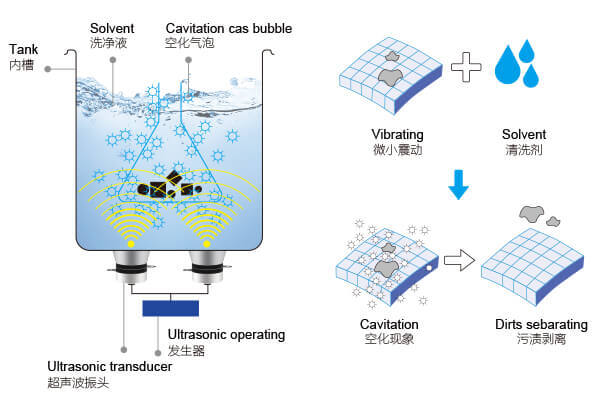
The Principle Behind Ultrasonic Cleaning
These pressure waves create alternating high- and low-pressure zones. During the low-pressure phase, microscopic bubbles can form in the liquid. During the high-pressure phase, the bubbles collapse. This process is called acoustic cavitation. The collapse produces localized pressure pulses and high-speed liquid movement that can detach contamination from surfaces, grooves, threads, holes, and other difficult-to-reach features.
Cleaning solution supports this physical process in several ways. Surfactants reduce surface tension and help the liquid wet the workpiece. Better wetting allows the liquid to enter small recesses and surround contamination more effectively. Other ingredients may dissolve oil, suspend removed particles, soften organic films, prevent corrosion, or chelate mineral deposits.
Water as the Liquid Medium
Water is important because acoustic cavitation cannot occur in an empty tank. The liquid must transmit pressure waves from the transducers to the workpiece. Water is widely used because it is available, relatively inexpensive, nonflammable, and compatible with many aqueous cleaning formulations.
However, water does not have the same cleaning ability as a formulated detergent. Its relatively high surface tension can limit penetration into small features, and it has limited ability to dissolve oils, grease, waxes, and many polishing residues. Hard water may also leave mineral spots after evaporation.
Filtered or deionized water can reduce mineral deposits and improve final rinsing. It does not, by itself, provide the chemical action required for heavy degreasing or tarnish removal. Water quality should therefore be selected together with the cleaning chemistry and final cleanliness requirement.
How Chemical Action Supports Acoustic Cavitation
An ultrasonic cleaning solution commonly contains a combination of surfactants, builders, emulsifiers, corrosion inhibitors, or chelating agents. The exact formulation depends on the material and contaminant. For example, an alkaline solution may help remove oils from metal parts, while a neutral detergent may be more appropriate for general cleaning of jewelry or eyewear.
The solution should not produce excessive foam. Foam introduces gas into the liquid and can interfere with the transmission of ultrasonic energy. A high-foaming household detergent may appear powerful during manual washing but perform poorly in an ultrasonic tank. Low-foaming formulations are generally more suitable because they preserve a more stable acoustic field.
Cleaning chemistry also influences corrosion. A solution that removes contamination from stainless steel may attack aluminum, copper, plated surfaces, solder joints, or sensitive coatings. Material compatibility must be verified before processing valuable or precision components.
When Plain Water May Be Enough
Plain water can be suitable when the contamination is loose, recent, and water-soluble. Examples include dust, light particles, some fingerprints, and certain residues that have not dried or chemically bonded to the surface. Hard glass, stainless steel, and selected plastic items may clean acceptably with water when the contamination load is low.
Water can also be used for a preliminary cleaning cycle or a final rinse. In a multistage process, the primary wash may use a detergent, followed by one or more water rinses to remove detergent residue and suspended contamination. Industrial systems often separate washing, rinsing, and drying because each stage has a different purpose.
Plain water may also be preferred when the object is sensitive to additives and the contamination is minimal. Even in this situation, a short test on a noncritical area is advisable. The water temperature, mineral content, and drying method can affect the final appearance.
When an Ultrasonic Cleaning Solution Is Necessary
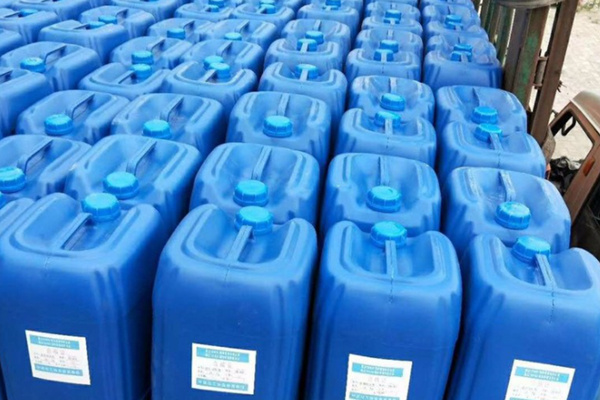
Ultrasonic Cleaning Agent
A formulated solution is generally required when the main contaminant is not readily soluble in water. Oil, grease, wax, polishing compound, carbon residue, and adhesive films normally need chemical assistance. Acoustic cavitation can loosen these materials, but the solution must also dissolve, emulsify, or suspend them to prevent redeposition.
For metal parts, the solution may be selected according to the production contamination. Machining oil and grease commonly require an alkaline or neutral degreaser. Polishing compound may require a warmer solution with stronger wetting and emulsifying performance. Carbon deposits and fuel varnish may need a specialized formulation and, in some cases, a separate pre-treatment stage.
Silver tarnish illustrates the limitation of water particularly well. Tarnish is primarily a chemically formed surface layer rather than loose dirt. Plain water can remove fingerprints and oil from silver, but it normally does not dissolve a bonded tarnish layer. A compatible silver-cleaning formulation may be needed, and the item must still be suitable for ultrasonic processing.
Rust also requires caution. Acoustic cavitation can remove loose particles and help expose corroded areas, but mechanical cleaning alone is not a complete treatment for chemically bonded iron oxide. A rust-removal chemistry, corrosion inhibitor, or separate restoration process may be required.
Organic contamination such as saliva proteins, food residue, and biofilm may also require a detergent or enzymatic formulation. Cleaning removes contamination, but it does not automatically sterilize an object. The Do Ultrasonic Cleaners Sterilize? guide explains the difference between physical cleaning and sterilization.
How to Select the Correct Cleaning Solution
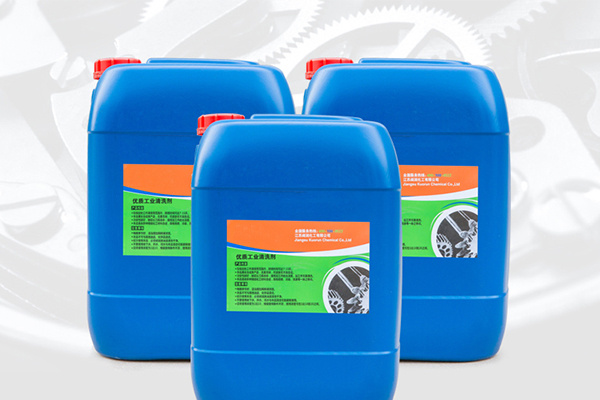
Cleaning Solution
Material Compatibility
The first selection factor is the material being cleaned. Stainless steel, aluminum, copper, brass, silver, glass, plastics, rubber, plated surfaces, and painted components can respond differently to the same chemistry. Aluminum is especially sensitive to alkaline and acidic conditions, while copper and brass may experience discoloration or dezincification if the chemistry is not controlled.
Plated jewelry and decorative finishes require additional care because the base metal may tolerate the solution while the surface coating does not. Adhesives, seals, elastomers, and optical coatings may also be affected by temperature or chemical exposure. The liquid should be evaluated together with the ultrasonic frequency and process time.
Ultrasonic cleaning efficiency directly depends on operating frequency and power density. Because lower frequencies can potentially cause damage to softer materials, cleaning chemistry must always be paired carefully with the equipment’s settings.
Low-Foaming Formulations
Professional ultrasonic detergents are normally designed to produce controlled foam. Excessive foam reduces the liquid volume available for effective acoustic transmission and may make the cleaning field less consistent. A low-foaming solution is particularly important when the tank is heated or when parts are processed in large batches.
Household dish soap can contain surfactants that remove grease, but it may also contain fragrances, dyes, thickeners, and ingredients that produce excessive foam. The Dish Soap in Ultrasonic Cleaners: Technical Compatibility Analysis guide explains why a product that works well for hand washing is not automatically suitable for ultrasonic equipment.
Concentration, Temperature, and Water Quality
Cleaning concentrates should be diluted according to the chemical supplier’s instructions. Increasing concentration beyond the recommended range may increase corrosion, residue, foaming, or disposal requirements without improving cleaning performance.
Moderate heating often improves cleaning because warmer liquids reduce viscosity and help dissolve oily contamination. Excessive temperature can damage plastics, soften adhesives, accelerate corrosion, or cause some residues to harden. The What Temperature Should You Use When Ultrasonic Cleaning Parts? guide provides additional information about the relationship between temperature and cleaning performance.
Water hardness also matters. Calcium and magnesium can create spots and deposits, particularly on glass, polished metal, optical parts, and jewelry. Deionized or filtered water may be beneficial for rinsing, but the primary wash still requires suitable chemistry when contamination is oily or strongly attached.
Can You Use Dish Soap, Vinegar, or Solvents?
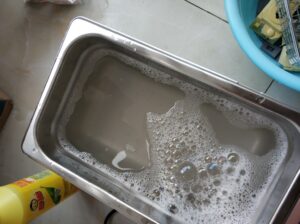
Image of an ultrasonic cleaner using dish soap as the cleaning agent.
Dish soap should not be the default solution for an ultrasonic cleaner. A small, diluted amount may be acceptable for limited low-risk use if the equipment and workpiece are compatible, but excessive foam is a common problem. A purpose-designed ultrasonic detergent is easier to control and usually provides more predictable cleaning.
Vinegar can dissolve some mineral deposits because it is acidic, but it is not a universal ultrasonic cleaning solution. Acidic liquids may attack aluminum, copper, brass, coatings, solder joints, or certain tank materials. Vinegar must never be mixed with bleach or incompatible chemicals.
Flammable solvents require particular caution. A standard ultrasonic tank may not have the ventilation, electrical protection, vapor control, or explosion-resistant construction needed for solvent use. Aqueous or semi-aqueous chemistry is often preferred because it can reduce solvent exposure and simplify wastewater management. Solvents should only be used in equipment specifically designed and approved for them.
Recommended Solutions for Common Applications
Jewelry and Eyewear
Jewelry and eyeglasses commonly accumulate skin oil, cosmetics, soap residue, dust, and polishing compound. A mild, low-foaming neutral solution is often more effective than water alone, provided the materials are suitable for ultrasonic cleaning.
The Jewelry Ultrasonic Cleaner category is relevant for small metal jewelry and similar compact items. The solution should not be assumed safe for every gemstone, plating, soldered joint, or damaged setting. Loose stones, porous gems, treated materials, and fragile assemblies may require manual cleaning or professional inspection.
For glasses, a solution should be compatible with lens coatings, frame materials, nose pads, and hinges. Aggressive chemistry may damage coatings even when the frame itself appears unaffected.
Automotive and Industrial Parts
Automotive parts often contain machining oil, grease, carbon, fuel varnish, and fine particles. Water alone generally provides limited degreasing performance. A compatible alkaline or neutral industrial detergent can improve emulsification and help keep removed contaminants suspended.
For larger or heavier components, tank capacity, basket load, frequency, power density, heating, filtration, and solution circulation become important. A separate pump or filter may improve liquid cleanliness, but circulation is independent of the acoustic cavitation generated by the ultrasonic transducers.
The Auto Parts Ultrasonic Cleaner category is intended for parts-cleaning applications where oil and mechanical contamination are central process concerns. The solution still needs to be selected according to the actual alloy, coating, seal material, and contaminant.
Dental Appliances and Instruments
Retainers, dentures, aligners, and mouthguards can collect plaque film, saliva residue, food particles, and mineral deposits. A mild solution compatible with the appliance material may improve cleaning compared with water alone. Manufacturer instructions for the appliance should take priority, especially for clear plastics, bonded components, and orthodontic devices.
Dental instruments require a controlled healthcare process. The liquid must be compatible with the instruments and the ultrasonic equipment, and cleaning must be followed by the required rinsing, inspection, disinfection, or sterilization stages. The Dental Equipment Ultrasonic Cleaner category is relevant to this application, but equipment selection does not replace validated infection-control procedures.