 Granbo Sonic










Do Ultrasonic Cleaners Sterilize?
Browse Volume:22 Classify:Support
No, ultrasonic cleaners do not sterilize instruments or objects. These devices perform highly effective cleaning by removing contaminants, debris, and significant amounts of microorganisms, but they cannot achieve the complete elimination of all microbial life required for true sterilization. The cavitation process that powers ultrasonic cleaning provides mechanical removal of bacteria, viruses, and fungi along with the organic material harboring them, yet this physical action alone cannot guarantee the destruction of all microorganisms, especially resistant bacterial spores.
The distinction between cleaning and sterilization represents a critical concept in medical, dental, laboratory, and food service settings. Ultrasonic cleaners excel at the cleaning phase, preparing items for subsequent sterilization processes. Studies measuring bacterial load before and after ultrasonic cleaning show reductions of 99% to 99.9% in many cases, which sounds impressive but falls far short of sterilization requirements.
Sterilization standards demand a 99.9999% reduction in microbial populations, often expressed as a six-log reduction or sterility assurance level of 10⁻⁶. This means fewer than one microorganism remains per million items processed. Ultrasonic cleaning, even under optimal conditions with antimicrobial solutions, typically achieves only two to three-log reductions.
Understanding this limitation prevents dangerous misconceptions in healthcare and other critical applications. Instruments destined for sterile body cavities, surgical procedures, or other high-risk uses must undergo proper sterilization after ultrasonic cleaning.

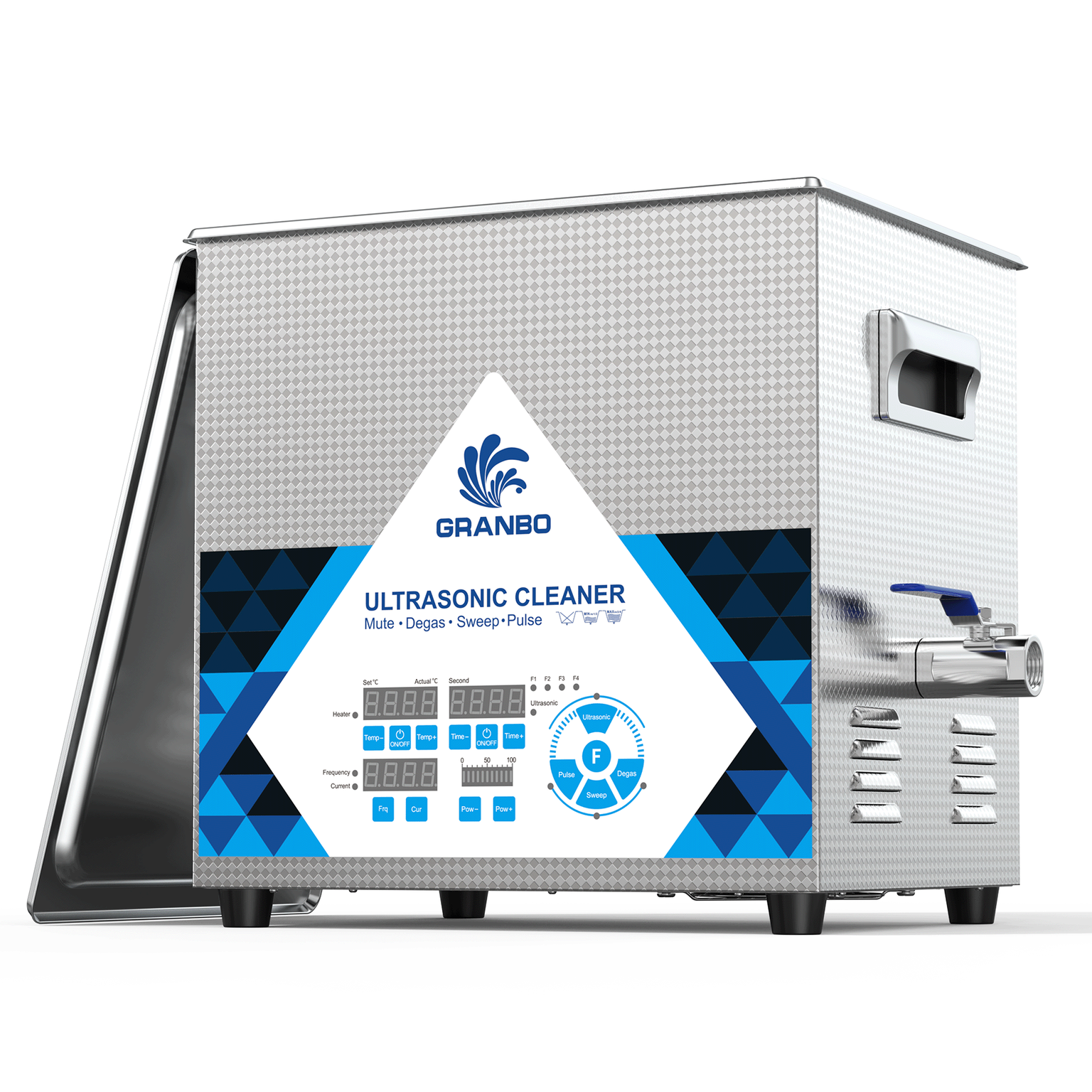
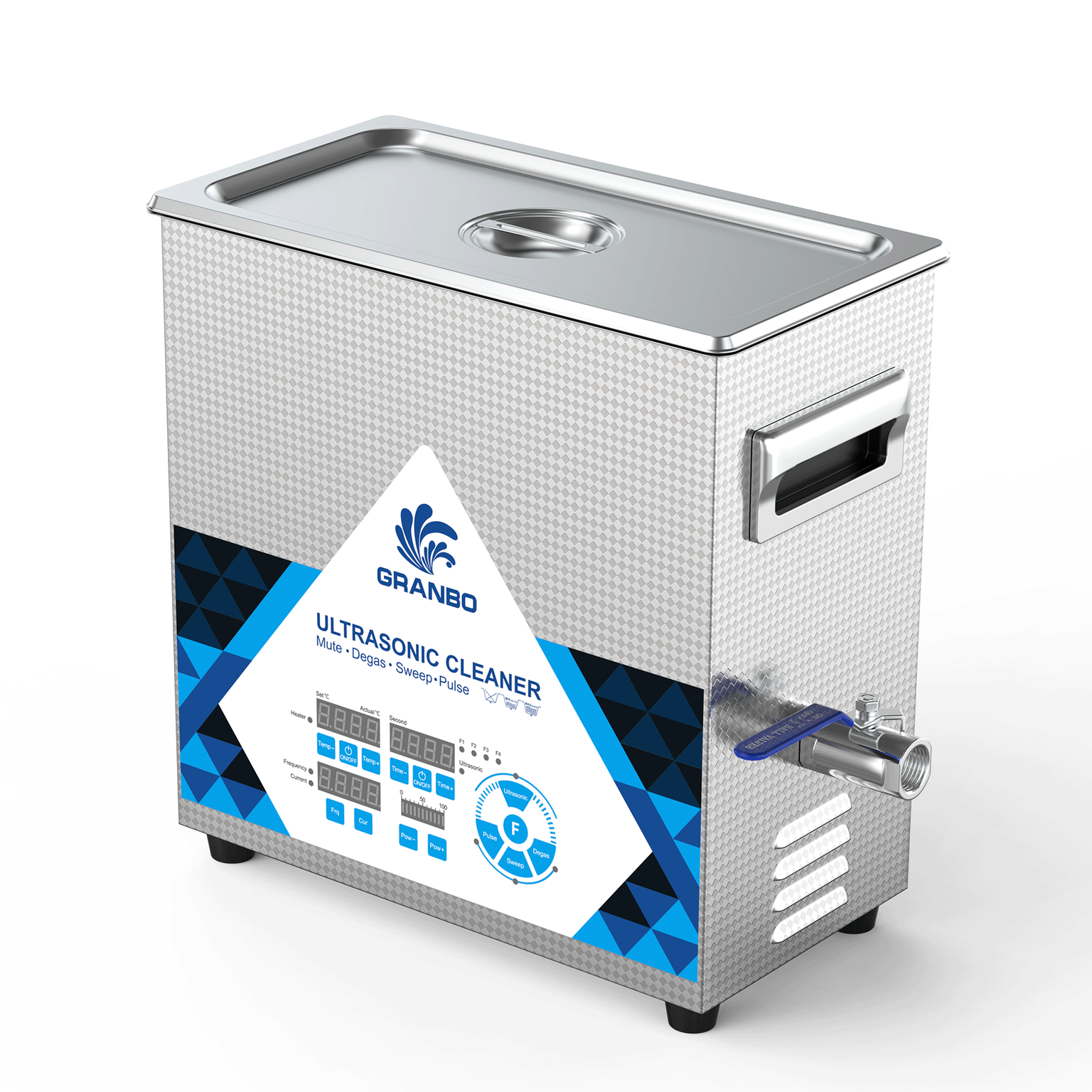
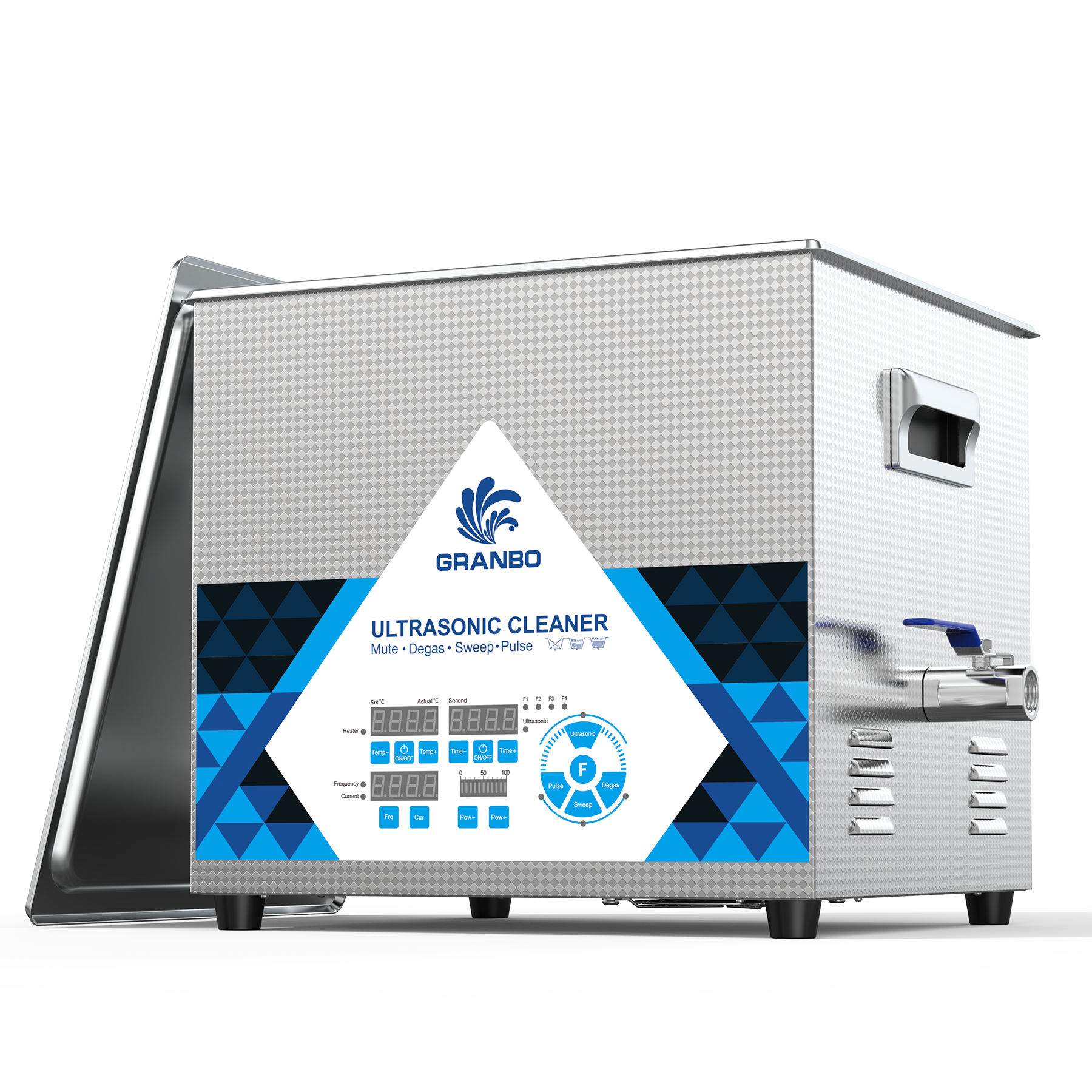
Granbo GL Series Ultrasonic Cleaners can be used in hospitals, laboratories, and other professional environments
Fundamental Difference Between Cleaning and Sterilization
Precise terminology clarifies the capabilities and limitations of different processes.
Definition of Cleaning
Cleaning removes visible soil, organic matter, and many microorganisms from surfaces through physical or mechanical action. The process targets dirt, blood, tissue, oils, and other contaminants that obscure or protect surfaces. Effective cleaning eliminates 80% to 99.9% of microorganisms present on objects, primarily through physical removal rather than microbial killing.
The cleaning process serves multiple purposes beyond simple appearance. Removing organic matter prevents it from interfering with subsequent sterilization or disinfection. Proteins and other biological materials can shield microorganisms from sterilizing agents or create barriers preventing heat penetration during autoclaving.
Definition of Sterilization
Sterilization completely destroys or eliminates all forms of microbial life including bacteria, viruses, fungi, and bacterial spores. This absolute standard leaves no viable organisms on processed items. The sterility assurance level quantifies this requirement. Medical device sterilization typically targets SAL of 10⁻⁶, meaning the theoretical probability of a single viable microorganism remaining on an item is one in one million.
Achieving sterilization requires specific validated processes including steam sterilization (autoclaving), ethylene oxide gas, hydrogen peroxide plasma, dry heat, or chemical sterilants. Each method has defined parameters including temperature, pressure, time, and concentration that must be met and monitored.
Definition of Disinfection
Disinfection occupies middle ground between cleaning and sterilization, eliminating most pathogenic microorganisms except bacterial spores. Disinfection levels vary from low to high depending on agent strength and contact time. High-level disinfection destroys all microorganisms except large numbers of bacterial spores.
Chemical disinfectants including bleach, alcohols, quaternary ammonium compounds, and phenolics provide disinfection when used at appropriate concentrations with adequate contact time. The effectiveness depends critically on prior cleaning removing organic matter that would inactivate disinfectants.
How Ultrasonic Cleaning Technology Functions
Understanding the operating principles explains both capabilities and limitations.
Cavitation Process Mechanics
Ultrasonic cleaning relies on cavitation, the formation and implosion of microscopic bubbles in liquid. Transducer activation converts electrical energy into mechanical vibration at frequencies between 20 kHz and 80 kHz. These vibrations propagate through cleaning solution creating alternating high-pressure and low-pressure waves.
During low-pressure phases, dissolved gases form tiny vacuum bubbles throughout the liquid. The bubbles grow over several acoustic cycles then collapse violently when pressure waves reverse. Implosion energy during bubble collapse creates localized extreme conditions with temperatures momentarily reaching thousands of degrees Celsius and pressures spiking to hundreds of atmospheres in microscopic zones.
The collapse generates shock waves and micro-jets of liquid shooting toward nearby surfaces at velocities exceeding 100 meters per second. These jets impact surfaces with substantial force, dislodging adhered contaminants.
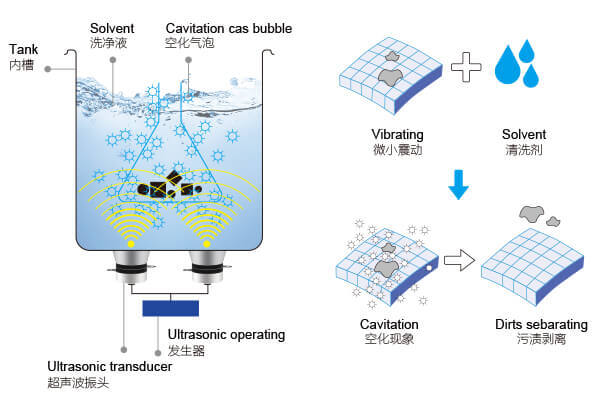
The Principle Behind Ultrasonic Cleaning
Physical Contaminant Removal
The mechanical action of cavitation excels at removing adherent materials from complex geometries. Particle dislodgement occurs as micro-jets from collapsing bubbles impact surfaces with enough force to break adhesion bonds. Dirt, blood, tissue fragments, oils, and other contaminants separate from underlying surfaces and suspend in the cleaning solution.
The cavitation penetrates into recesses, hinges, lumens, and textured surfaces impossible to reach with brushes or cloths. Bubbles forming within microscopic crevices collapse and blast contamination outward. This access to hidden surfaces makes ultrasonic cleaning invaluable for complex surgical instruments.
Why Cavitation Alone Cannot Kill Microorganisms
Despite intense localized energy, cavitation does not reliably destroy microorganisms. The extreme temperature and pressure conditions during bubble collapse exist only in microscopic zones for microseconds. A bacterium must be in the immediate collapse vicinity at the exact moment of implosion to experience lethal conditions.
The vast majority of microorganisms present in cleaning solution or on surfaces never experience direct cavitation effects. They undergo mechanical dislodgement and mixing but not the intense collapse energy. These organisms remain viable after removal from surfaces. Bacterial spore resistance exceeds even direct cavitation energy in many cases.
Microbial Reduction Through Ultrasonic Cleaning
Scientific studies measuring microbial populations before and after ultrasonic cleaning reveal typical performance. Laboratory testing using standardized bacterial contamination on instruments shows ultrasonic cleaning with appropriate detergents reduces bacterial counts by 2 to 3 logs, or 99% to 99.9%. This substantial reduction represents excellent cleaning but falls approximately 3 logs short of sterilization requirements.
Biofilm disruption represents an important cleaning benefit. Bacterial biofilms, the slimy protective matrices bacteria create on surfaces, resist conventional cleaning. The mechanical energy from cavitation helps break apart biofilm structure, exposing embedded bacteria to cleaning chemicals. However, biofilm bacteria released during ultrasonic disruption become free-floating viable organisms.
Bacterial spores including Bacillus and Clostridium species show minimal susceptibility to ultrasonic cleaning. Testing using Geobacillus stearothermophilus spores found ultrasonic cleaning reduced spore counts by less than 90% even with extended treatment times and elevated temperatures. The spore coat structure provides extraordinary protection that only validated sterilization processes reliably overcome.
Temperature and Chemical Effects
Temperature
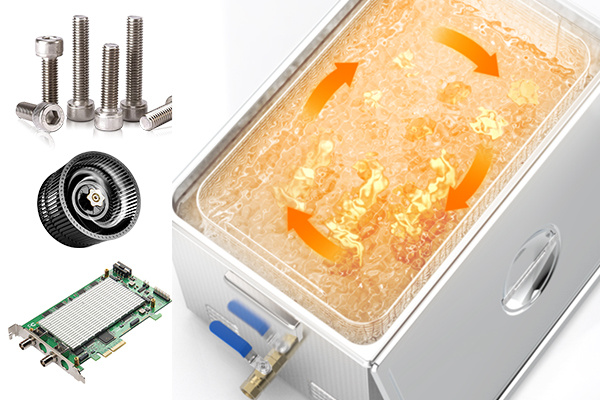
Most ultrasonic cleaners operate between 50 and 65 degrees Celsius during normal use. This temperature range balances enzyme activity in cleaning solutions, cavitation intensity, and user safety. Temperature contributes to microbial reduction but not to sterilization levels. Thermal death of vegetative bacteria occurs at temperatures above 60 degrees Celsius with adequate time, but typical ultrasonic cleaning cycles run 5 to 15 minutes, providing insufficient exposure for reliable thermal disinfection.
Purpose-designed enzymatic cleaners optimize organic matter removal. Multi-enzyme formulations typically include proteases breaking down proteins, lipases attacking fats and oils, and amylases digesting starches. The enzymatic action accelerates organic matter breakdown compared to simple detergent solutions, removing the nutrition source and protective matrix for microorganisms.
Some ultrasonic cleaning solutions incorporate antimicrobial agents for enhanced microbial reduction. Quaternary ammonium compounds at concentrations around 0.1% to 0.5% offer low-level disinfection while maintaining cleaning effectiveness. However, the short contact time during ultrasonic cleaning limits disinfectant effectiveness compared to extended immersion protocols.
Medical and Dental Industry Standards
Healthcare applications have established protocols recognizing ultrasonic cleaning as one step in instrument processing. Professional standards emphasize cleaning before sterilization or disinfection. CDC Guidelines for disinfection and sterilization in healthcare facilities specify cleaning as the first essential step in instrument reprocessing, stating “cleaning must precede all disinfection and sterilization processes.”
Organic matter protection allows microorganisms to survive sterilization processes. Proteins coagulate in autoclave heat creating physical barriers preventing steam penetration to embedded bacteria. Blood and tissue absorb sterilant chemicals reducing concentration reaching microorganisms. Testing comparing sterilization success on cleaned versus uncleaned instruments shows dramatic differences.
The FDA device classification determines processing requirements. Critical devices entering sterile tissue require sterilization. Semi-critical devices contacting mucous membranes require high-level disinfection minimum. Both categories require thorough cleaning before terminal processing.
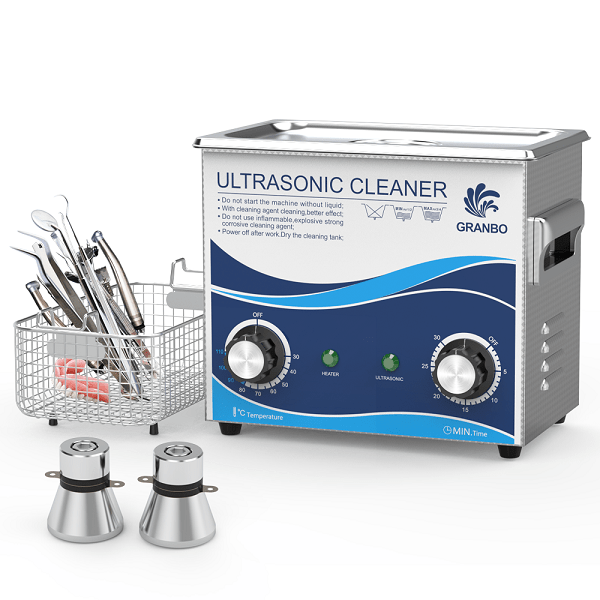
Dental Instrument Ultrasonic Cleaner
Achieving Sterilization After Ultrasonic Cleaning
Autoclave Sterilization
Steam sterilization under pressure provides the most common and reliable sterilization method. Gravity displacement autoclaves typically run 30 minutes at 121 degrees Celsius at 15 psi, or 15 minutes at 132 degrees Celsius at 27 psi. These conditions reliably kill all microorganisms including spores.
Pre-vacuum autoclaves actively remove air before steam admission creating better steam penetration into complex items and packages. Biological indicators containing Geobacillus stearothermophilus spores verify autoclave performance. These indicators placed in challenging load locations undergo processing then incubation to confirm effectiveness.
Chemical Sterilization Methods
Liquid and gas chemical sterilants provide alternatives for heat-sensitive items. Glutaraldehyde sterilization requires 2% solution at 20 to 25 degrees Celsius for 10 hours. Items must be completely immersed and lumens filled with solution. After processing, thorough rinsing removes toxic residues before items contact patients.
Hydrogen peroxide plasma sterilization uses low-temperature hydrogen peroxide gas with radiofrequency energy creating reactive plasma. The process operates at 45 to 55 degrees Celsius making it suitable for heat-sensitive items with short cycles of 28 to 75 minutes.
Ethylene oxide gas sterilization handles extremely heat-sensitive items and large loads. The process requires 1 to 6 hours of gas exposure followed by extended aeration removing toxic residues. The toxicity and explosion hazard require special facility design.
Common Misconceptions About Ultrasonic Sterilization
Several myths persist regarding ultrasonic cleaning capabilities. The misconception that heat plus ultrasonic action equals sterilization ignores the fundamental temperature and time requirements for microbial killing. Standard ultrasonic cleaners operate at 50 to 65 degrees Celsius, far below the 121 to 135 degrees Celsius required for steam sterilization.
Another common myth suggests extended cleaning time compensates for temperature limitations. Thermal death follows logarithmic kinetics where temperature dramatically affects kill rate. Extending 60-degree cleaning from 10 minutes to 10 hours would not approach the lethality of even 1 minute at 121 degrees Celsius.
Marketing claims sometimes blur the distinction between cleaning, sanitizing, and sterilizing. Terms like “hospital-grade cleaning” or “99.9% germ removal” sound impressive but describe cleaning effectiveness, not sterilization. Consumers and even some professionals may misinterpret such language as indicating sterilization capability.
Proper Workflow for Instrument Processing
Comprehensive instrument processing follows a validated sequence.
Step 1 involves pre-cleaning and rinsing at point of use preventing blood and tissue from drying on surfaces.
Step 2 uses ultrasonic cleaning with appropriate enzymatic or antimicrobial solutions for 5 to 15 minutes at optimal temperature.
Step 3 requires thorough rinsing removing all cleaning solution residues and loosened contaminants.
Step 4 applies appropriate sterilization or high-level disinfection based on instrument classification. Critical items undergo steam sterilization, chemical sterilization, or other validated methods. Semi-critical items receive high-level disinfection. Step 5 maintains sterility through proper packaging and storage until next use.
Each step contributes essential value. Skipping ultrasonic cleaning may leave organic matter protecting microorganisms during sterilization. Skipping sterilization after cleaning leaves viable organisms on instruments regardless of how clean they appear.
Testing and Validation Methods
Biological indicators provide the gold standard for sterilization validation. These test systems contain known populations of highly resistant bacterial spores. After exposure to the sterilization process, indicators undergo incubation. Spore survival indicates process failure requiring investigation and corrective action.
Chemical indicators change color confirming exposure to sterilization conditions. These provide immediate visual confirmation but don’t prove actual sterilization occurred. Multiple indicator types may be used including integrators responding to time, temperature, and specific sterilant presence.
ATP testing measures biological contamination quantifying cleaning effectiveness. The test detects adenosine triphosphate present in all living cells. High ATP readings after cleaning indicate inadequate soil removal requiring reprocessing or process improvement.
When Ultrasonic Cleaning Suffices vs When Sterilization Required
Application context determines processing requirements. Medical and surgical instruments entering sterile body cavities always require sterilization after cleaning. Dental instruments contacting oral tissues require sterilization or high-level disinfection depending on specific use.
Laboratory glassware for sterile cell culture requires sterilization. General laboratory glassware for non-sterile applications needs only thorough cleaning. Food service items require cleaning and sanitization but not sterilization. Industrial parts may need only cleaning removing manufacturing oils and debris.
The key decision factors include whether items contact sterile tissues, mucous membranes, or intact skin. Items entering the body require sterilization. Items contacting mucous membranes need high-level disinfection minimum. Items touching only intact skin require cleaning and low-level disinfection.
Best Practices for Maximum Microbial Reduction
Optimizing ultrasonic cleaning effectiveness maximizes microbial reduction even though sterilization remains unachievable. Use appropriate solutions formulated for ultrasonic application with enzymatic or antimicrobial properties. Maintain optimal temperature between 50 and 60 degrees Celsius balancing cavitation intensity and chemical activity.
Allow adequate time with most applications requiring 5 to 15 minutes depending on soil level and item complexity. Proper loading ensures solution circulation and cavitation access to all surfaces. Items should not touch or overlap.
Change solution regularly as accumulated soil reduces effectiveness. Many facilities change solution after each load or when visibly contaminated. Rinse thoroughly after ultrasonic cleaning removing all solution residues before proceeding to sterilization.
Inspect items under magnification after cleaning confirming removal of all visible soil. Any remaining debris requires re-cleaning before sterilization. Document processes including solution type, temperature, time, and date creating accountability and quality records.
Train staff on proper techniques, safety precautions, and the distinction between cleaning and sterilization. Understanding why each step matters improves compliance and protects patients.
Ultrasonic cleaning technology provides exceptional cleaning performance accessing complex geometries and removing stubborn contamination. The mechanical cavitation action combined with appropriate chemical solutions reduces microbial populations substantially. However, the fundamental limitations of the process prevent achievement of sterility. Recognizing ultrasonic cleaning as an essential but incomplete step in instrument processing ensures proper workflow design. Following validated protocols using ultrasonic cleaning for its strengths while applying appropriate sterilization methods for microbial elimination protects patient safety and meets regulatory standards.