 Granbo Sonic












Do Ultrasonic Contact Lens Cleaners Work?
Browse Volume:46 Classify:Support
Contact lens wearers constantly seek more effective ways to keep their lenses clean and comfortable. Ultrasonic cleaning technology, proven successful for jewelry and dental appliances, has entered the contact lens care market with promising claims. However, the delicate nature of contact lenses and the critical importance of eye health demand a thorough examination of whether these devices deliver genuine benefits or simply represent another gadget with limited practical value.
Understanding Ultrasonic Contact Lens Cleaners
What Are Ultrasonic Contact Lens Cleaners
Ultrasonic contact lens cleaners are compact devices specifically designed to clean contact lenses using high-frequency sound waves. These units typically feature small cleaning chambers sized to accommodate standard contact lens cases, with frequencies ranging from 40 kHz to 68 kHz. The devices are marketed as convenient solutions for removing protein deposits, lipids, and other debris that accumulate on lens surfaces during normal wear.
Most consumer models operate on USB power or batteries, making them portable for travel. The cleaning chambers hold just enough solution to submerge a pair of lenses in their storage cases. Unlike larger ultrasonic cleaners used for jewelry or instruments, contact lens models are purpose-built with lower power outputs intended to protect delicate lens materials from potential damage.
How the Technology Functions
Ultrasonic cleaning operates through cavitation, a process where high-frequency sound waves create microscopic bubbles in liquid. These bubbles form and collapse rapidly, generating tiny shock waves that dislodge contaminants from surfaces. The frequency determines bubble size and cleaning intensity, with higher frequencies producing smaller, gentler bubbles more suitable for delicate items.
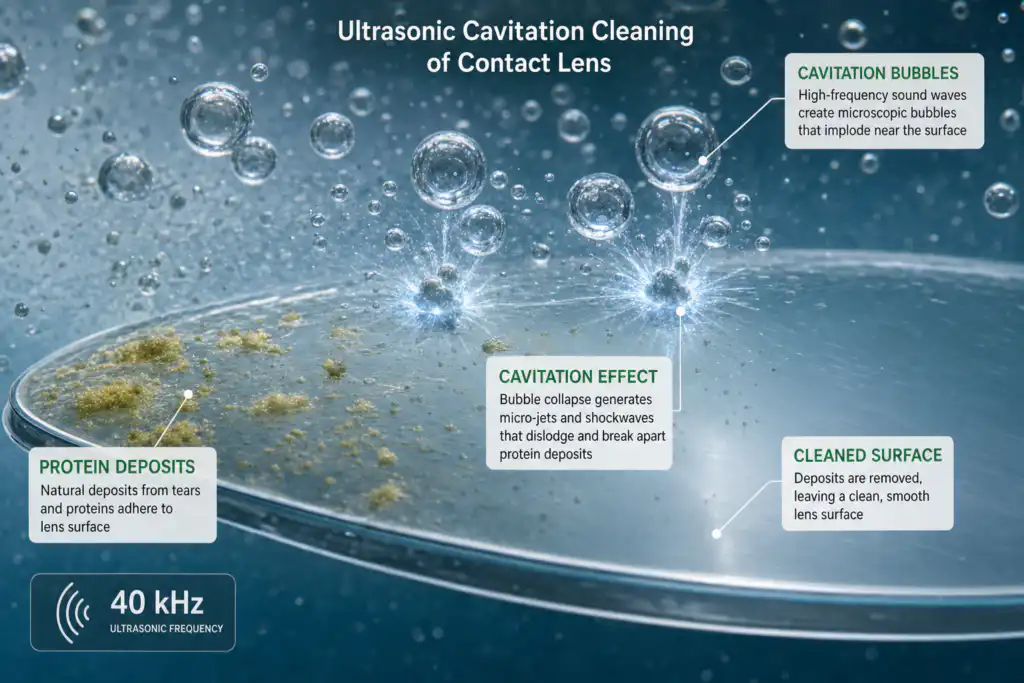
Microscopic view showing cavitation bubbles removing protein deposits from contact lens surface
For contact lens applications, the ultrasonic transducer vibrates at frequencies that create cavitation without excessive mechanical stress. The bubbles penetrate microscopic surface irregularities where deposits accumulate, theoretically providing more thorough cleaning than simple soaking. The entire process occurs within the contact lens solution, combining mechanical action with the solution’s chemical cleaning properties.
Design Principles for Lens Care
Contact lens ultrasonic cleaners must balance cleaning effectiveness with material safety. Lens materials, particularly soft hydrogel and silicone hydrogel lenses, are far more delicate than metal or glass items typically cleaned ultrasonically. The design challenge involves generating sufficient cavitation to remove stubborn deposits while avoiding lens damage.
Frequency selection plays a crucial role in this balance. Lower frequencies around 25 kHz to 35 kHz create larger, more aggressive bubbles suitable for heavy-duty cleaning but potentially damaging to soft materials. Contact lens cleaners typically operate at 40 kHz or higher, producing gentler cleaning action. Some premium models offer adjustable power settings to accommodate different lens types and cleaning needs.
Do Ultrasonic Cleaners Actually Work for Contact Lenses?
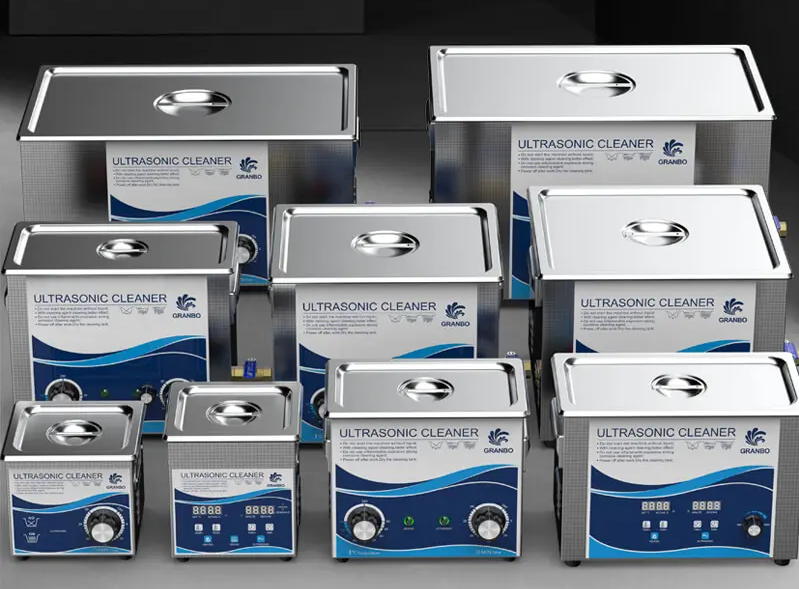
Granbo ultrasonic cleaners
The Short Answer
Yes, ultrasonic cleaners can work for contact lenses, but with important qualifications. The technology does remove deposits more effectively than simple soaking in some situations, particularly for rigid gas permeable lenses and heavily soiled soft lenses. However, effectiveness varies significantly based on lens type, deposit nature, solution chemistry, and device quality. Ultrasonic cleaning does not replace proper chemical disinfection and should be viewed as a supplementary cleaning step rather than a complete care solution.
The key word is “supplementary.” No ultrasonic cleaner alone provides the disinfection necessary to safely wear contact lenses. These devices remove physical debris and deposits but do not kill bacteria, fungi, or other pathogens that pose serious infection risks. Proper contact lens solutions with antimicrobial properties remain essential regardless of whether ultrasonic cleaning is used.
Evidence of Cleaning Effectiveness
Laboratory testing demonstrates that ultrasonic energy does enhance removal of certain deposits from contact lens surfaces. Protein films, which build up from tear components during lens wear, show improved removal rates when ultrasonic cleaning supplements chemical cleaning. Studies comparing soaking alone versus soaking with ultrasonic agitation show measurably cleaner lens surfaces after ultrasonic treatment.
The cleaning advantage appears most pronounced for specific deposit types. Lipid deposits, which come from oils in tears and skin contact, respond well to ultrasonic disruption. These oily films often resist simple soaking but break apart under cavitation forces. Similarly, makeup residues, dust particles, and other physical contaminants dislodge more readily with ultrasonic assistance.
However, the magnitude of improvement varies considerably. Some studies show dramatic enhancement, while others demonstrate only modest benefits over thorough manual rubbing and rinsing. The inconsistency suggests that device quality, solution selection, and lens condition significantly influence results. Not all ultrasonic cleaners deliver the same performance, and optimal effectiveness requires proper technique.
Limitations and Constraints
Ultrasonic cleaning faces several practical limitations for contact lens care. First, the gentle frequencies required to avoid lens damage also limit cleaning power. The same cavitation that removes deposits can potentially disrupt lens materials if too aggressive. This necessitates conservative power levels that may not thoroughly remove all deposit types.
Second, ultrasonic energy cannot penetrate deeply into the lens matrix where some deposits become embedded. Surface deposits dislodge readily, but proteins and other substances that partially absorb into hydrogel materials resist mechanical cleaning. Chemical action from enzymatic cleaners or hydrogen peroxide systems addresses these embedded deposits more effectively than ultrasonic vibration.
Third, effectiveness depends heavily on proper solution use. Ultrasonic energy enhances whatever cleaning solution is present, but it cannot compensate for expired, inappropriate, or insufficient solution. Some contact lens wearers mistakenly believe ultrasonic cleaning allows them to skimp on quality solutions, when in reality the opposite is true. Premium solutions formulated for ultrasonic enhancement deliver better results than generic or improvised alternatives.
How Ultrasonic Cleaning Affects Contact Lenses
600ml 15W 50KHz Glasses cleaning
Protein Deposit Removal
Protein deposits represent the most common and problematic accumulation on contact lenses. Tear proteins, particularly lysozyme, albumin, and immunoglobulins, adhere to lens surfaces and denature over time, forming cloudy films that reduce vision quality and comfort. These protein layers also trigger inflammatory responses in some wearers, causing redness and irritation.
Ultrasonic cavitation disrupts protein deposits by creating microscopic pressure variations across the lens surface. The rapid bubble formation and collapse physically breaks protein bonds and lifts deposits away from the lens material. This mechanical action complements enzymatic cleaners, which chemically break down proteins into smaller, more soluble fragments.
Testing shows that combining ultrasonic cleaning with enzymatic solutions produces superior protein removal compared to either method alone. The synergy occurs because enzymes weaken protein structures, making them more susceptible to mechanical disruption. Conversely, ultrasonic agitation increases solution contact with deposits, improving enzyme access and reaction rates.
Lipid and Debris Elimination
Lipid deposits from tear film oils and skin contact create another cleaning challenge. These oily substances resist water-based solutions and can form stubborn films that blur vision. Makeup residues, particularly around lens edges, compound the problem for many wearers. Traditional soaking addresses lipids through surfactants in multipurpose solutions, but removal rates vary.
Ultrasonic energy improves lipid removal by disrupting oil films and emulsifying fatty deposits into smaller droplets. The cavitation bubbles create localized turbulence that breaks apart continuous oil layers, allowing surfactants in the cleaning solution to work more effectively. Edge deposits, which accumulate in the junction between lens surfaces, particularly benefit from ultrasonic cleaning due to improved solution penetration.
Physical debris like dust, pollen, and atmospheric particles generally responds well to ultrasonic cleaning. These contaminants sit on lens surfaces without chemical bonding, making them easy targets for cavitation. A brief ultrasonic cycle typically removes such debris completely, whereas soaking alone may leave particles loosely attached.
Surface Integrity Considerations
The interaction between ultrasonic energy and lens materials raises important questions about potential surface damage. Soft contact lenses, made from hydrogel or silicone hydrogel polymers, have delicate structures that could theoretically degrade under excessive mechanical stress. Concerns include surface roughening, microscopic tears, or alteration of lens parameters like curvature and diameter.
Research examining lens surfaces before and after ultrasonic cleaning yields mixed results. Studies using appropriate frequencies (40 kHz or higher) and moderate power levels generally show no significant surface damage on modern lens materials. High-resolution microscopy reveals that properly executed ultrasonic cleaning does not create scratches, pits, or other structural defects.
However, excessive cleaning duration, inappropriate frequencies, or excessively powerful devices can cause problems. Some early studies using lower frequencies or extended cleaning times documented surface changes including increased roughness and minor structural alterations. These findings emphasize the importance of following manufacturer guidelines regarding cleaning duration and power settings.
Lens parameter stability also deserves attention. Contact lenses must maintain precise optical properties and dimensional accuracy. Testing of lenses subjected to regular ultrasonic cleaning shows no clinically significant changes in power, diameter, base curve, or other critical parameters when proper protocols are followed. This stability reassures users that appropriate ultrasonic cleaning will not alter lens fit or vision correction.
Safety Concerns and Material Compatibility
Soft Lens Compatibility Issues
Soft contact lenses, including daily, biweekly, and monthly replacement schedules, dominate the contact lens market. These lenses use water-absorbing polymers that create comfortable, flexible optics. However, the same properties that make soft lenses comfortable also make them more vulnerable to physical stress compared to rigid materials.
Hydrogel lenses, particularly older-generation materials, show greater sensitivity to ultrasonic cleaning than newer silicone hydrogel formulations. The higher water content in traditional hydrogels creates more opportunities for cavitation to affect the lens matrix. Silicone hydrogel materials, with lower water content and stronger polymer networks, generally tolerate ultrasonic cleaning better.
Most ultrasonic contact lens cleaner manufacturers specify compatibility with FDA Group I through Group IV soft lenses, covering the full range of hydrogel and silicone hydrogel materials. However, some premium specialty lenses, including custom toric or multifocal designs, may have manufacturer restrictions against ultrasonic cleaning. Verifying compatibility with the specific lens brand and material prevents potential issues.
Daily disposable lenses present a unique consideration. Since these lenses are discarded after single use, deposit accumulation is minimal and ultrasonic cleaning offers little practical benefit. The technology targets extended-wear lenses where deposits build up over days or weeks. Attempting to ultrasonically clean daily disposables is unnecessary and potentially wasteful.
RGP and Hard Lens Performance
Rigid gas permeable lenses and hard contact lenses respond exceptionally well to ultrasonic cleaning. These materials are inherently more durable than soft lenses, tolerating higher cavitation intensities without damage risk. The non-porous surfaces of rigid lenses also mean deposits remain primarily on the surface rather than absorbing into the material, making them ideal targets for mechanical cleaning.
Eye care professionals often recommend ultrasonic cleaning specifically for RGP lens wearers. The firmer lens materials allow use of more powerful cleaning cycles that thoroughly remove stubborn deposits. Many RGP wearers report improved comfort and vision clarity when incorporating ultrasonic cleaning into their care routines, particularly if they experience heavy protein or lipid deposition.
Scleral lenses, large-diameter rigid lenses that vault over the cornea, also benefit from ultrasonic cleaning. The larger surface area and complex geometries of scleral lenses can accumulate deposits in areas difficult to clean manually. Ultrasonic energy reaches all surfaces uniformly, ensuring comprehensive cleaning across the entire lens including fenestrations and peripheral curves.
Potential Damage Mechanisms
Understanding how ultrasonic cleaning might damage contact lenses helps users avoid problems. The primary risk involves excessive cavitation intensity causing microscopic structural disruption. If bubbles collapse too violently against the lens surface, they can create tiny stress points that weaken polymer chains or separate laminated lens layers in certain specialty designs.
Another concern involves resonance effects. If the ultrasonic frequency happens to match a natural resonant frequency of the lens material or geometry, energy absorption increases dramatically. This resonance can cause heating or mechanical stress beyond normal levels. Quality contact lens ultrasonic cleaners are designed with frequencies that avoid common resonance issues, but extremely cheap or poorly designed units might not incorporate these safeguards.
Physical contact between lenses and hard surfaces during ultrasonic cleaning also poses risks. If lenses vibrate against plastic or metal case walls, scratching can occur. Proper case design with soft surfaces or suspension systems prevents this problem. Users should always ensure lenses are fully submerged and positioned correctly in their cases before starting ultrasonic cycles.
Comparing Ultrasonic Cleaning to Traditional Methods
Chemical Disinfection Systems
Multipurpose solutions represent the most common contact lens care approach. These all-in-one products clean, rinse, disinfect, and store lenses through chemical action alone. They contain surfactants for cleaning, antimicrobial agents for disinfection, and conditioning agents for comfort. The simplicity of multipurpose solutions appeals to users seeking convenience.
Ultrasonic cleaning does not replace multipurpose solutions but can enhance their effectiveness. The mechanical action helps surfactants penetrate deposits more quickly and thoroughly. However, the disinfection component, which requires specific contact time between antimicrobial agents and microorganisms, still depends entirely on chemical action. Ultrasonic energy does not contribute to disinfection in standard contact lens care protocols.
Comparing cleaning performance, ultrasonic-assisted multipurpose solution cleaning generally outperforms soaking alone, particularly for heavily deposited lenses. The difference becomes most apparent when lenses approach the end of their replacement cycle and have accumulated significant buildup. For relatively clean lenses changed frequently, the advantage narrows considerably.
Enzymatic Cleaners
Enzymatic cleaners use proteins like protease or subtilisin to break down protein deposits chemically. These products typically come as tablets dissolved in saline for weekly or bi-weekly use. Enzymes work by catalyzing the hydrolysis of protein bonds, converting large protein molecules into smaller peptides and amino acids that rinse away easily.
The combination of enzymatic cleaning and ultrasonic energy creates a powerful synergy. Enzymes work more efficiently when deposits are physically disrupted, exposing more surface area to enzyme action. Simultaneously, ultrasonic cavitation helps distribute enzymes uniformly across lens surfaces and into microscopic crevices. Studies show this combination removes proteins more completely than either method independently.
From a practical standpoint, using ultrasonic cleaning during enzymatic treatments makes excellent sense. The weekly or bi-weekly enzymatic cleaning schedule aligns well with periodic deep cleaning via ultrasonic methods. This approach provides thorough deposit removal without daily ultrasonic cleaning, which most users find unnecessarily time-consuming.
Hydrogen Peroxide Solutions
Hydrogen peroxide systems offer powerful disinfection through oxidation. These solutions use 3 percent hydrogen peroxide to kill microorganisms, then neutralize to safe saline through catalytic converters or neutralizing tablets. Peroxide systems clean effectively and avoid preservatives that can cause sensitivity in some users.
Ultrasonic cleaning theoretically complements peroxide systems well. The mechanical action could enhance peroxide contact with deposits and biofilms. However, practical considerations limit this combination. Most peroxide systems require specific contact times in closed cases for safety, with neutralization occurring automatically after the prescribed period. Adding ultrasonic cleaning would require modifying this process.
Some advanced users perform ultrasonic cleaning in multipurpose solution before transferring lenses to peroxide systems for overnight disinfection. This two-step approach combines thorough mechanical cleaning with powerful chemical disinfection. However, the added complexity and time investment may discourage routine use for many contact lens wearers.
Proper Usage Guidelines for Contact Lens Ultrasonic Cleaners
Solution Selection Requirements
Never use plain water or improvised solutions in ultrasonic contact lens cleaners. Water alone lacks the surfactants, pH buffers, and osmotic balance necessary for safe contact lens care. Additionally, water can harbor microorganisms that pose serious infection risks. Always use FDA-approved contact lens solutions specifically formulated for cleaning and disinfecting.
Multipurpose solutions work well for ultrasonic cleaning. Their surfactant packages benefit from ultrasonic enhancement, improving cleaning efficiency. Saline solutions provide a suitable medium for ultrasonic energy transmission but lack cleaning agents, limiting their effectiveness to physical debris removal without deposit dissolution.
Some manufacturers produce solutions specifically formulated for ultrasonic contact lens cleaning. These specialized products optimize surfactant concentrations and foam control for ultrasonic environments. While not essential, they may provide incremental performance benefits over standard multipurpose solutions, particularly for heavy deposit removal.
Cleaning Cycle Duration
Most contact lens ultrasonic cleaners recommend cycle times between 10 and 30 seconds per cleaning session. This duration provides sufficient cavitation action to remove protein deposits, tear film residues, and other surface contaminants without exposing the lenses to unnecessary ultrasonic energy. Many dedicated contact lens cleaners use preset cleaning cycles within this range.
Longer cleaning times do not necessarily improve cleaning performance and may increase the risk of unnecessary wear on lens materials over time. Once surface contaminants have been loosened and suspended in the cleaning solution, additional ultrasonic exposure offers little additional benefit.
For routine daily cleaning, a 10–30 second cycle is generally sufficient. If lenses have accumulated heavier deposits, a second 10–30 second cycle can be performed using fresh contact lens solution. Excessively long cleaning cycles are generally unnecessary for regular contact lens maintenance.
Frequency Recommendations
Daily ultrasonic cleaning is generally unnecessary and potentially excessive for most contact lens wearers. The time investment and potential material fatigue from daily mechanical stress outweigh the marginal benefits for lenses that receive proper daily chemical cleaning. Most eye care professionals recommend ultrasonic cleaning as a weekly or bi-weekly supplement rather than a daily routine.
Extended-wear lens users who keep lenses in for multiple days might benefit from more frequent ultrasonic cleaning when lenses are removed. The continuous wear allows deposits to accumulate more rapidly, making mechanical cleaning more valuable. However, extended-wear lenses require meticulous care protocols, and ultrasonic cleaning should complement, not replace, thorough chemical disinfection.
RGP lens wearers often ultrasonically clean more frequently, sometimes daily, due to the material’s durability and tendency to accumulate surface deposits. The more robust nature of rigid lenses tolerates regular mechanical cleaning without the concerns applicable to soft lenses. Individual deposit accumulation rates vary, so frequency should be adjusted based on lens comfort and clarity.
When Ultrasonic Cleaning Makes Sense
Specific Lens Types
Rigid gas permeable lens wearers gain the most consistent benefits from ultrasonic cleaning. The durable lens materials tolerate regular mechanical cleaning, and the non-porous surfaces respond well to cavitation-based deposit removal. Many long-term RGP wearers consider ultrasonic cleaners essential care accessories.
Extended-wear soft lens users who remove lenses periodically for cleaning also benefit significantly. The longer wear time between removals allows heavier deposit accumulation that responds well to mechanical cleaning assistance. However, this application requires strict adherence to disinfection protocols since infection risks increase with extended wear.
Monthly replacement soft lenses, particularly in the final week before replacement, may show improvement with ultrasonic cleaning. As lenses age and deposits accumulate despite daily cleaning, the supplementary mechanical action can restore comfort and clarity. This extends practical wear time until the scheduled replacement date.
Heavy Deposit Situations
Individuals who naturally produce high levels of tear proteins or lipids often struggle with deposit accumulation regardless of lens type or care routine. For these users, ultrasonic cleaning provides measurable comfort and vision benefits. The mechanical deposit removal supplements chemical cleaning that may be overwhelmed by excessive deposit rates.
Environmental factors also influence deposit accumulation. Dusty or polluted environments, occupational exposures to particles or chemicals, and frequent makeup use all increase deposit burdens on contact lenses. Ultrasonic cleaning helps manage these situations more effectively than chemical cleaning alone.
Allergy sufferers whose eyes produce increased mucus and protein during allergy seasons may find seasonal ultrasonic cleaning beneficial. The temporary increase in deposits during pollen seasons can make lenses uncomfortable despite regular care. Adding ultrasonic cleaning during peak allergy periods addresses this temporary challenge without requiring permanent routine changes.
Supplementary Cleaning Approach
The most sensible perspective views ultrasonic cleaning as a supplementary tool rather than a primary care method. It enhances rather than replaces proper chemical cleaning and disinfection. This mindset prevents overreliance on the technology while allowing users to benefit from its genuine advantages.
Incorporating ultrasonic cleaning into a weekly deep-cleaning routine makes practical sense. Pairing it with enzymatic treatments or periodic peroxide disinfection creates a comprehensive care approach that addresses both routine daily needs and accumulated long-term deposits. This balanced strategy optimizes lens longevity and wearing comfort without excessive complexity.
The technology serves best as a problem-solving tool for specific situations rather than a universal requirement. Users experiencing comfort issues, reduced vision clarity, or visible deposits despite proper care might benefit from trying ultrasonic cleaning. Those satisfied with traditional care methods have little reason to add ultrasonic cleaning unless they develop future needs.
Frequently Asked Questions
Can ultrasonic cleaners replace regular contact lens solution?
No, ultrasonic cleaners cannot replace contact lens solution. These devices enhance the mechanical cleaning action of solutions but provide no disinfection capability. Contact lenses must be cleaned and disinfected with FDA-approved solutions regardless of whether ultrasonic cleaning is used. The ultrasonic device requires solution to function and works by improving how that solution removes deposits. Never use ultrasonic cleaners with plain water or as a substitute for proper chemical disinfection.
How often should contact lenses be cleaned with an ultrasonic cleaner?
For soft contact lenses, weekly or bi-weekly ultrasonic cleaning typically provides optimal results without excessive material stress. Daily ultrasonic cleaning is generally unnecessary and may shorten lens lifespan through cumulative mechanical fatigue. Rigid gas permeable lenses tolerate more frequent ultrasonic cleaning, with some wearers cleaning daily without issues. Individual needs vary based on deposit accumulation rates, so frequency should be adjusted based on lens comfort and clarity. Always follow the specific recommendations provided with the lens and ultrasonic device.
Is ultrasonic cleaning safe for daily disposable contact lenses?
While ultrasonic cleaning will not immediately damage daily disposable lenses, it serves no practical purpose. Daily disposables are designed for single-use and discarded after each wear, preventing significant deposit accumulation. The minimal deposits that occur during one-day wear do not justify ultrasonic cleaning. Additionally, the mechanical stress from ultrasonic cleaning, though minimal, is unnecessary for lenses that will be thrown away. Save ultrasonic cleaning for extended-wear lenses where deposit management matters.
Will ultrasonic cleaning damage soft contact lenses?
Properly executed ultrasonic cleaning at appropriate frequencies (40 kHz or higher) and durations (10-30 seconds) does not damage modern soft contact lens materials. Research shows no significant surface changes, parameter alterations, or structural degradation when manufacturer guidelines are followed. However, excessive cleaning duration, inappropriate low frequencies, or defective devices could potentially cause problems. Always use devices specifically designed for contact lenses and follow all usage instructions carefully.
Can ultrasonic cleaning remove all types of contact lens deposits?
Ultrasonic cleaning effectively removes surface deposits including proteins, lipids, makeup residues, and environmental debris. However, it cannot remove deposits that have penetrated deeply into the lens matrix, which sometimes occurs with proteins in high-water-content hydrogel materials. For these embedded deposits, chemical action from enzymatic cleaners or hydrogen peroxide systems works more effectively. Ultrasonic cleaning works best as part of a comprehensive care routine that combines mechanical and chemical cleaning methods.
Do eye doctors recommend ultrasonic contact lens cleaners?
Eye care professionals hold varied opinions, with recommendations often depending on individual patient needs. Many optometrists recommend ultrasonic cleaners for rigid gas permeable lens wearers and patients with heavy deposit problems. For average soft lens wearers with good hygiene habits, opinions range from mildly positive to neutral. The consensus emphasizes that ultrasonic cleaning supplements rather than replaces proper chemical care. Patients should discuss their specific situation with their eye care provider before adding ultrasonic cleaning to their routine.