 Granbo Sonic











Ultrasonic Contact Lens Cleaners: Performance Analysis and Application Guidelines
Browse Volume:13 Classify:Support
Ultrasonic contact lens cleaners represent a specialized application of cavitation technology designed to address protein deposits, lipid accumulation, and microbial contamination on lens surfaces. These devices operate on the same fundamental principles as larger ultrasonic cleaning systems but incorporate design modifications specific to the delicate nature of contact lens materials. The effectiveness of these cleaners depends on multiple factors including lens type, solution chemistry, operational parameters, and adherence to manufacturer protocols.
Understanding Ultrasonic Cleaning Technology for Contact Lenses
Ultrasonic cleaning systems generate high-frequency sound waves through piezoelectric transducers mounted beneath a cleaning chamber. Contact lens ultrasonic cleaners typically operate at frequencies between 58 kHz and 70 kHz, higher than standard ultrasonic cleaners which run at 40 kHz. When these sound waves propagate through liquid cleaning solution, they create alternating cycles of compression and rarefaction. During rarefaction phases, microscopic vacuum bubbles form throughout the liquid in a process called cavitation. These bubbles collapse violently during compression phases, generating localized pressure waves and microscopic jets that dislodge contaminants from surfaces.
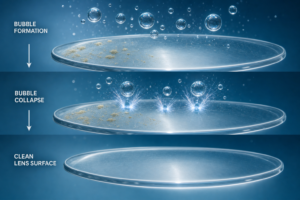
Diagram showing ultrasonic cavitation bubbles forming and collapsing around a contact lens surface
How Ultrasonic Cavitation Affects Lens Surfaces
The cavitation process produces cleaning forces at a microscale level that manual rubbing cannot replicate. When bubbles collapse near a contact lens surface, they create pressure differentials capable of breaking the bonds between deposited proteins and the lens polymer matrix. This mechanical action supplements the chemical cleaning provided by enzymatic or surfactant-based solutions.
Contact lens materials present unique challenges for ultrasonic cleaning. Modern soft lenses incorporate hydrogel or silicone hydrogel polymers with water content ranging from 38% to 78%. These materials maintain structural integrity through a balance of polymer cross-linking and water absorption. Excessive ultrasonic energy can potentially disrupt this balance, causing microstructural damage that compromises oxygen permeability or optical clarity.
Rigid gas permeable lenses, manufactured from fluorosilicone acrylate or similar materials, exhibit greater resistance to mechanical stress. The denser polymer structure and lower water content make RGP lenses more suitable for ultrasonic cleaning applications. Clinical studies have documented protein removal rates exceeding 85% for RGP lenses subjected to ultrasonic treatment, compared to 60-70% removal rates with manual cleaning alone.
Frequency and Power Specifications in Contact Lens Applications
Frequency selection represents a critical parameter in ultrasonic contact lens cleaner design. Standard ultrasonic cleaners operate at 40 kHz, producing moderate-sized cavitation bubbles suitable for general cleaning tasks. Contact lens cleaners utilize higher frequencies between 58-70 kHz, generating smaller cavitation bubbles that collapse with gentler force. This frequency range provides effective cleaning action while minimizing mechanical stress on delicate lens polymers.
High-end precision lens cleaning systems may operate at frequencies between 80-120 kHz for ultra-delicate applications. These elevated frequencies produce microscopic bubbles with extremely gentle cavitation forces, ideal for specialty lenses or materials sensitive to mechanical agitation. However, the majority of consumer contact lens cleaners employ the 58-70 kHz range as the optimal balance between cleaning effectiveness and material safety.
Power output, measured in watts per unit volume, determines cavitation intensity. Contact lens cleaners typically operate between 20-50 watts, significantly lower than industrial ultrasonic systems. This reduced power prevents excessive mechanical stress while maintaining sufficient cleaning efficacy. Power density calculations must account for the small cleaning chamber volume, typically 50-200 milliliters in contact lens applications.
Temperature management interacts directly with ultrasonic performance. Cavitation intensity increases with temperature up to approximately 60°C, beyond which vapor pressure begins to cushion bubble collapse. Contact lens cleaning solutions generally perform optimally between 35-45°C, warm enough to enhance protein solubility and enzymatic activity without approaching the glass transition temperature of lens polymers.
Effectiveness of Ultrasonic Contact Lens Cleaners
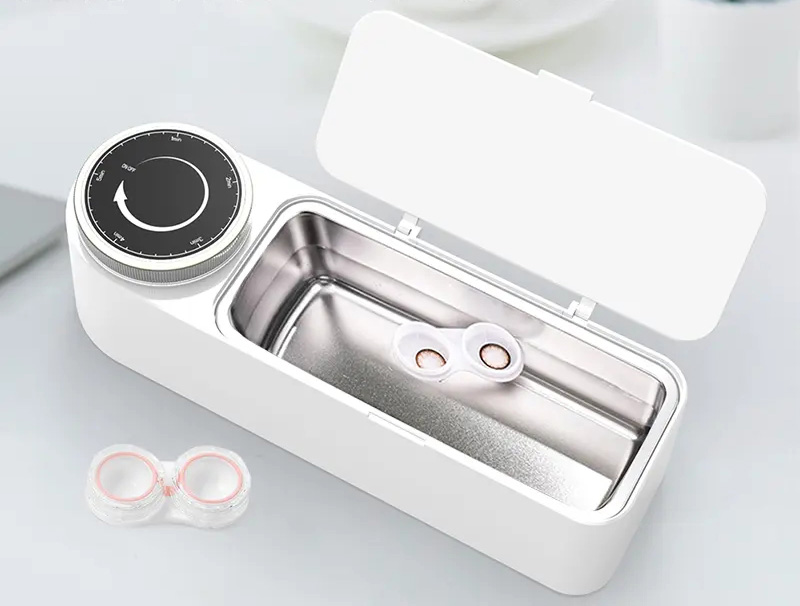
Ultrasonic Contact Lens Cleaner
Clinical evaluations and laboratory testing have established performance benchmarks for ultrasonic contact lens cleaning under controlled conditions. Effectiveness varies substantially based on deposit type, lens material, solution formulation, and operational parameters.
Protein Deposit Removal Capabilities
Protein deposits represent the primary contamination challenge for contact lens wearers. Tear film proteins, particularly lysozyme, lactoferrin, and lipocalin, denature upon contact with lens surfaces and form tenacious bonds with polymer matrices. These deposits accumulate progressively, reducing oxygen transmission, increasing bacterial adhesion risk, and degrading optical performance.
Ultrasonic cleaning demonstrates superior performance for protein removal compared to manual methods. Laboratory studies using artificially aged lenses with standardized protein loading show 75-90% removal efficiency with ultrasonic treatment combined with enzymatic cleaning solutions. Manual rubbing with the same solutions achieves 50-65% removal under identical test conditions.
The enhancement derives from ultrasonic cavitation’s ability to penetrate surface irregularities and polymer matrix interstices inaccessible to manual contact. Protein molecules bonded within these microscale features experience mechanical disruption from collapsing cavitation bubbles while enzymatic agents simultaneously break down peptide bonds. This synergistic effect exceeds the performance of either cleaning mechanism alone.
Lipid and Debris Elimination Performance
Lipid deposits originate from meibomian gland secretions and cosmetic residues. These hydrophobic compounds resist water-based cleaning solutions and require surfactant action for effective removal. Ultrasonic agitation enhances surfactant penetration into lipid layers and accelerates emulsification processes.
Testing with fluorescently labeled lipids demonstrates 80-95% removal efficiency when combining ultrasonic treatment with surfactant-containing solutions. The mechanical energy from cavitation disrupts the lipid film integrity, allowing surfactant molecules to intercalate more effectively. Temperature elevation during ultrasonic operation further reduces lipid viscosity, facilitating removal.
Particulate debris, including dust, makeup particles, and environmental contaminants, responds well to ultrasonic cleaning. The omnidirectional nature of cavitation bubble collapse dislodges particles from all lens surfaces simultaneously, including edge regions and posterior curves difficult to access through manual cleaning.
Comparison with Manual Cleaning Methods
Manual cleaning protocols recommended by ophthalmology organizations emphasize the “rub and rinse” technique. This approach requires applying solution to the lens, rubbing with a clean finger for 20-30 seconds per side, and rinsing thoroughly. While effective when performed correctly, manual cleaning suffers from inconsistent application and technique variation among users.
Comparative studies measuring residual protein levels after cleaning show ultrasonic methods reduce deposit mass by 25-40% compared to manual techniques when both employ identical solutions. However, this advantage diminishes significantly when users perform manual cleaning with poor technique. Properly executed manual cleaning approaches ultrasonic performance for surface deposits but remains less effective for embedded contaminants.
The time efficiency factor favors ultrasonic cleaning. A typical ultrasonic cycle operates for 3-5 minutes without requiring active user participation, compared to 1-2 minutes of hands-on effort for manual cleaning. Users can prepare for bed or complete other tasks while ultrasonic cleaning progresses, improving compliance with daily cleaning requirements.
Safety Considerations for Different Lens Types
Material compatibility represents the most critical safety consideration when evaluating ultrasonic contact lens cleaners. Not all lens types tolerate ultrasonic exposure equally, and manufacturer specifications must guide application decisions.
Soft Contact Lens Compatibility
Modern soft contact lenses encompass diverse material formulations with varying mechanical properties. First-generation hydrogel lenses, manufactured from hydroxyethyl methacrylate polymers, exhibit relatively low tensile strength and tear resistance. Extended ultrasonic exposure can induce edge tears, parameter changes, or surface roughening in these materials.
Third-generation silicone hydrogel lenses incorporate strengthened polymer structures with improved mechanical durability. Materials such as lotrafilcon B, comfilcon A, and delefilcon A demonstrate better tolerance for ultrasonic cleaning. Clinical evaluations show no significant parameter changes or structural damage after 30 daily ultrasonic cleaning cycles using appropriate frequency and power settings.
However, several soft lens manufacturers explicitly advise against ultrasonic cleaning in their care instructions. This guidance reflects conservative risk management rather than documented damage evidence in many cases. The liability considerations surrounding potential lens damage or reduced performance influence manufacturer recommendations.
Daily disposable lenses require no cleaning and should never undergo ultrasonic treatment. Two-week and monthly replacement lenses represent borderline applications where ultrasonic cleaning may provide marginal benefit insufficient to justify potential risks. Extended wear lenses designed for 3-6 month replacement cycles present the most suitable soft lens application for ultrasonic cleaning.
Rigid Gas Permeable Lens Performance
RGP lenses demonstrate excellent compatibility with ultrasonic cleaning systems. The material hardness, dimensional stability, and resistance to mechanical stress make these lenses ideal candidates for ultrasonic treatment. Practitioners frequently recommend ultrasonic cleaning for RGP lens wearers as part of comprehensive deposit management strategies.
Long-term studies following RGP lens wearers using daily ultrasonic cleaning show no accelerated parameter drift, surface quality degradation, or optical performance decline compared to manual cleaning cohorts. Some data suggests reduced deposit-related complications and extended lens longevity in ultrasonic cleaning groups.
The primary consideration for RGP ultrasonic cleaning involves solution compatibility. Certain RGP cleaning solutions contain abrasive particles designed for manual friction cleaning. These abrasives can damage ultrasonic cleaner chambers and transducers. Only solutions explicitly approved for ultrasonic use should be employed in these devices.
Material-Specific Limitations
Specialty contact lenses, including scleral lenses, orthokeratology lenses, and custom soft lenses, require individualized assessment. Scleral lenses, with their larger diameter and rigid construction, generally tolerate ultrasonic cleaning well. The increased surface area and tendency toward protein accumulation in the bowl region make ultrasonic treatment particularly beneficial.
Orthokeratology lenses undergo precision manufacturing to create specific reverse geometry designs. Any parameter changes from aggressive cleaning could compromise the reshaping effect. Conservative ultrasonic settings or manual cleaning may be preferable for these lenses pending additional research data.
Hybrid lenses combining rigid centers with soft skirts present conflicting material requirements. The differential response of these materials to ultrasonic energy creates risk for delamination at the junction interface. Most hybrid lens manufacturers recommend against ultrasonic cleaning pending design modifications to improve junction durability.
Proper Usage Guidelines for Optimal Results
Achieving optimal cleaning performance while minimizing lens damage risk requires adherence to specific operational protocols. Deviations from recommended procedures can reduce effectiveness or compromise lens integrity.
Solution Selection and Compatibility
The cleaning solution employed in ultrasonic treatment determines both chemical and mechanical cleaning contributions. Multi-purpose contact lens solutions designed for cleaning, rinsing, disinfecting, and storage provide adequate performance for routine ultrasonic cleaning. These solutions contain surfactants, chelating agents, and antimicrobial preservatives that supplement ultrasonic mechanical action.
Enzymatic cleaners specifically formulated for protein removal offer enhanced performance for heavily deposited lenses. Enzyme tablets or liquid formulations contain proteolytic enzymes that catalyze peptide bond hydrolysis. Combining enzymatic chemistry with ultrasonic cavitation produces synergistic cleaning effects exceeding either method alone.
Hydrogen peroxide systems present compatibility concerns for ultrasonic cleaning. The catalytic neutralization process these systems employ may be disrupted by ultrasonic agitation, potentially leaving residual peroxide that causes ocular irritation. If using hydrogen peroxide systems with ultrasonic cleaning, the cleaning phase should precede the neutralization cycle.
Solution volume must be sufficient to completely submerge lenses while maintaining acoustic coupling between transducers and the cleaning chamber. Inadequate solution depth creates inconsistent cavitation intensity and reduces cleaning effectiveness. Most devices specify minimum fill lines that should be observed consistently.
Cleaning Cycle Duration and Frequency
Optimal cleaning cycle duration balances thoroughness against potential mechanical stress. Laboratory testing indicates plateau protein removal occurring between 3-5 minutes of ultrasonic treatment. Extended cycles beyond 8-10 minutes provide minimal additional benefit while increasing cumulative mechanical stress on lens materials.
Standard recommended protocols specify 3-minute cycles for daily cleaning maintenance. Weekly deep cleaning may employ 5-7 minute cycles combined with enzymatic solutions to address accumulated deposits. Users should avoid repeated back-to-back cycles, as this concentrates mechanical stress and may exceed material fatigue thresholds.
Frequency recommendations vary by lens type and replacement schedule. Monthly replacement soft lenses may benefit from 2-3 ultrasonic cleanings per week alternated with manual cleaning. Extended wear soft lenses and RGP lenses on longer replacement schedules can undergo daily ultrasonic treatment as part of routine care.
Incorporating ultrasonic cleaning into consistent evening routines improves compliance. Initiating the cleaning cycle immediately upon lens removal, followed by solution fill and overnight storage, ensures adequate disinfection time while leveraging the hands-free nature of ultrasonic operation.
Temperature and Maintenance Requirements
Temperature monitoring prevents excessive heat that could damage lens materials or reduce solution effectiveness. While moderate warming enhances cleaning, temperatures exceeding 50°C risk protein denaturation into more tenacious deposits and may approach polymer glass transition temperatures.
Most contact lens ultrasonic cleaners lack active heating elements, relying on waste heat from transducer operation. This passive warming typically elevates solution temperature 5-10°C above ambient during a standard cleaning cycle. In hot environments, pre-cooling cleaning solution prevents excessive temperature elevation.
Regular maintenance preserves ultrasonic cleaner performance and prevents contamination. Weekly cleaning of the chamber with mild detergent removes deposited contaminants and prevents biofilm formation. Monthly inspection of transducer surfaces identifies scaling or corrosion that reduces acoustic coupling efficiency.
Periodic performance verification using aluminum foil erosion tests confirms adequate cavitation intensity. Suspending a small piece of aluminum foil in the cleaning chamber during operation should produce visible pitting within 30-60 seconds if cavitation intensity remains sufficient for effective cleaning.
Common Misconceptions and Limitations
Several widespread misconceptions regarding ultrasonic contact lens cleaners create unrealistic expectations or inappropriate usage patterns.
The belief that ultrasonic cleaning eliminates disinfection requirements represents a dangerous misunderstanding. Ultrasonic treatment provides mechanical cleaning that reduces microbial load through physical removal but does not achieve sterilization. Proper disinfection using approved chemical systems or heat treatment remains mandatory after ultrasonic cleaning to prevent microbial keratitis and other infections.
Some users assume ultrasonic cleaning can restore damaged or degraded lenses to original condition. While effective deposit removal may improve clarity and comfort of contaminated lenses, ultrasonic treatment cannot reverse parameter changes, heal edge tears, or eliminate permanent surface modifications. Lenses showing structural damage require replacement regardless of cleaning method.
The misconception that higher power or longer cycles improve results drives some users to exceed manufacturer recommendations. Beyond optimal parameters, additional ultrasonic exposure produces diminishing returns while accelerating material fatigue. Following specified power settings and cycle durations provides better long-term outcomes than aggressive over-treatment.
Limitations of ultrasonic cleaning include reduced effectiveness for certain deposit types. Calcium deposits from hard water exposure or tear film imbalances may resist ultrasonic removal without specialized chelating agents. Fungal contamination penetrating lens matrices cannot be adequately addressed through any cleaning method, necessitating lens replacement.