 Granbo Sonic












Do Ultrasonic Record Cleaners Work?
Browse Volume:11 Classify:Support
Yes, ultrasonic record cleaners can work effectively for removing dust, fingerprints, mold residue, pressing residue, and other contamination from vinyl record grooves. Their main advantage is that the cleaning liquid can reach areas that are difficult to contact with a brush or vacuum wand. When the process is properly designed, ultrasonic cleaning can reduce pops, crackle, and surface noise caused by removable contamination.
The cleaning result depends on more than the presence of an ultrasonic transducer. Record spacing, rotation, water quality, cleaning-fluid chemistry, filtration, drying, label protection, and the condition of the record all affect the final result. Ultrasonic cleaning cannot repair scratches, groove wear, warping, damaged vinyl, or pressing defects.
What Ultrasonic Record Cleaners Actually Remove
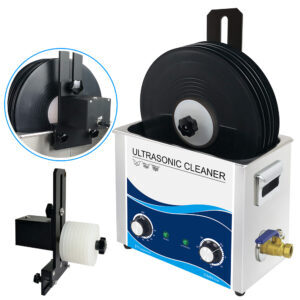
Granbo Ultrasonic Cleaner with Motorized Vinyl Record Bracket for cleaning multiple records at once
Dust, Fingerprints, and Organic Residue
Vinyl records collect contamination from handling, storage, inner sleeves, turntable mats, and the surrounding environment. Common deposits include skin oil, fingerprints, dust, smoke residue, airborne particles, mold residue, and remnants of previous cleaning products.
Ultrasonic cleaning can loosen contamination that is attached to the record surface but remains removable. The process is particularly useful when particles are embedded in the groove walls or mixed with an oily film that prevents dry brushing from removing them.
Specialized record-cleaning solutions may also help remove residues left during pressing or manufacturing. Some record-cleaning manufacturers formulate fluids to improve groove wetting and remove organic or oily contamination. Tri-Art, for example, describes its record-cleaning formulation as suitable for ultrasonic and vacuum record-cleaning systems and identifies fingerprints, dust, grime, and grease as target contaminants. See Record Cleaner (Tri-Art Manufacturing).
Ultrasonic cleaning does not make every record visually perfect. A record may remain noisy because of scratches, groove wear, non-fill, warping, damaged vinyl, or permanent contamination that has altered the groove surface.
Contamination Inside Record Grooves
A vinyl groove contains fine modulations that carry the audio signal. Dust and residue can settle into the groove valleys, where a standard cloth or dry brush may not reach completely.
The cleaning liquid must enter the groove for ultrasonic cleaning to work effectively. Water naturally tends to form droplets on some hydrophobic plastic surfaces, so a suitable wetting agent may improve contact between the liquid and the groove walls. GrooveWasher describes its ultrasonic concentrate as a surfactant and emulsifier intended to reduce water surface tension and improve groove penetration. See G•Sonic Ultrasonic Concentrate (GrooveWasher).
The goal is not to create a heavily concentrated detergent bath. Excess surfactant can produce foam, leave residue, complicate rinsing, and affect drying. Record-cleaning chemistry should be low-residue and compatible with vinyl, labels, spindle fixtures, and the cleaning equipment.
What Ultrasonic Cleaning Cannot Repair
Ultrasonic cleaning removes contamination; it does not restore damaged groove geometry. Scratches, groove wear, pressing defects, permanent scuffing, heat damage, and warping remain after cleaning.
A record that has been played with a damaged stylus may contain permanent groove wear. Cleaning can remove dirt that makes the noise worse, but it cannot recreate the original groove surface.
Mold presents a similar limitation. Ultrasonic cleaning may loosen mold residue and associated particles, but records with active mold growth require careful isolation, handling, cleaning, and drying. The surrounding sleeve, inner bag, storage area, and other records may also need attention.
How Ultrasonic Record Cleaning Works
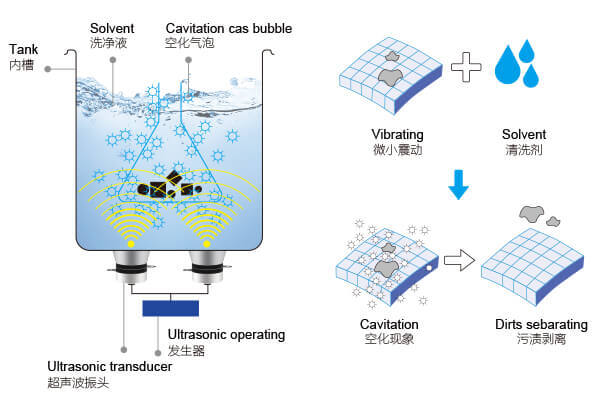
The Principle Behind Ultrasonic Cleaning
Acoustic Cavitation
An ultrasonic record cleaner uses a generator and transducers to transmit high-frequency pressure waves through the cleaning liquid. Under suitable conditions, these waves create microscopic bubbles that form and collapse throughout the bath.
The collapse of the bubbles produces localized turbulence, shear forces, and liquid microjets near immersed surfaces. These forces help detach particles and films from the record. This process is called acoustic cavitation.
Ultrasonic cleaning should not be described as mechanical stirring. If a record-cleaning system includes a motorized spindle, pump, filtration loop, or spray function, those components perform separate mechanical or fluid-handling functions. The ultrasonic cleaning action comes from acoustic cavitation generated by the transducers.
Cleaning performance depends on the acoustic field, record position, water level, bath temperature, solution chemistry, and distance between records. A high-power machine is not automatically better. Excessive acoustic energy or heat may increase the risk of record deformation, label damage, or residue problems.
Record Rotation and Groove Access
Many ultrasonic record cleaners use a motorized spindle to rotate several records through the cleaning bath. Rotation exposes different parts of the groove surface to the acoustic field and helps maintain consistent liquid contact.
Record spacing is important. If records are mounted too closely together, the liquid may not circulate evenly between them. Close spacing can also create acoustic shadowing, where one record reduces the ultrasonic exposure received by an adjacent record.
The spindle should hold records securely without pressing against the playing surface. The record labels should remain above the liquid when the equipment design requires label protection. A damaged or improperly fitted clamp can allow water to reach the label or create mechanical stress around the center hole.
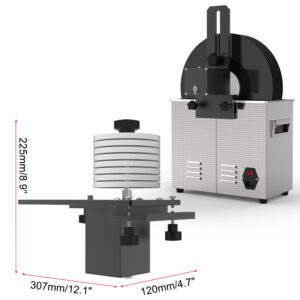
Granbo Motorized Vinyl Record Cleaning Bracket with dimensions, rotating rack for ultrasonic cleaning multiple records
Cleaning Solution and Surface Tension
Distilled or deionized water is commonly selected for ultrasonic record cleaning because it contains fewer dissolved minerals than tap water. Lower mineral content helps reduce water spots and deposits during drying.
A small amount of a record-safe wetting agent may improve liquid contact with the grooves. The selected product should be intended for vinyl records and used at the specified concentration. Household dish soap, strongly fragranced detergents, and high-foam cleaners may leave residues or make rinsing difficult.
Some systems use a small amount of alcohol, while others specify alcohol-free chemistry. The correct choice depends on the record-cleaning system, fluid formulation, vinyl compatibility, label protection, and manufacturer instructions. Alcohol should not be added by assumption because concentration, exposure time, additives, and temperature affect material compatibility.
How Effective Are Ultrasonic Record Cleaners?
Effects on Pops, Crackle, and Surface Noise
Ultrasonic cleaning can reduce noise caused by removable particles, oily films, dried residue, and contamination inside the groove. When the stylus no longer encounters those particles, playback may produce fewer clicks, pops, and crackle.
Results vary between records. A lightly dusty record may show a limited improvement because the contamination was already easy to remove. A heavily handled record with oily deposits or deep groove contamination may show a more noticeable change.
Noise reduction is not guaranteed. A record with scratches, groove wear, non-fill, pressing defects, or permanent damage may remain noisy after the cleaning process. Listening tests should be performed only after the record is fully rinsed and dried.
Differences Between New and Used Records
New records can contain manufacturing residue, paper fibers, dust, and particles from sleeves or handling. A new record is not necessarily free of contamination. Ultrasonic cleaning may remove residue that was introduced during pressing, packaging, or transport.
Used records may contain a wider range of contamination, including skin oils, smoke residue, dried cleaning fluid, mold, and particles transferred from poor storage. Heavy contamination may require a pre-cleaning stage before the ultrasonic bath.
A manual pre-clean can remove loose surface dirt and reduce the soil load placed into the ultrasonic tank. GrooveWasher recommends manual cleaning before ultrasonic treatment as part of its preferred record-cleaning process. See G•Sonic Ultrasonic Concentrate (GrooveWasher).
Factors That Affect Results
Important process variables include:
- Ultrasonic frequency and acoustic power
- Record spacing on the spindle
- Cleaning-fluid concentration
- Water purity
- Bath temperature
- Cleaning time
- Filtration and bath replacement
- Record rotation speed
- Label and spindle protection
- Drying method and storage conditions
Frequency affects bubble behavior, but frequency alone does not predict the final result. Cleaner design, transducer distribution, tank geometry, record position, and solution chemistry may be more important than a single frequency number printed in a product specification.
How to Use an Ultrasonic Record Cleaner Correctly
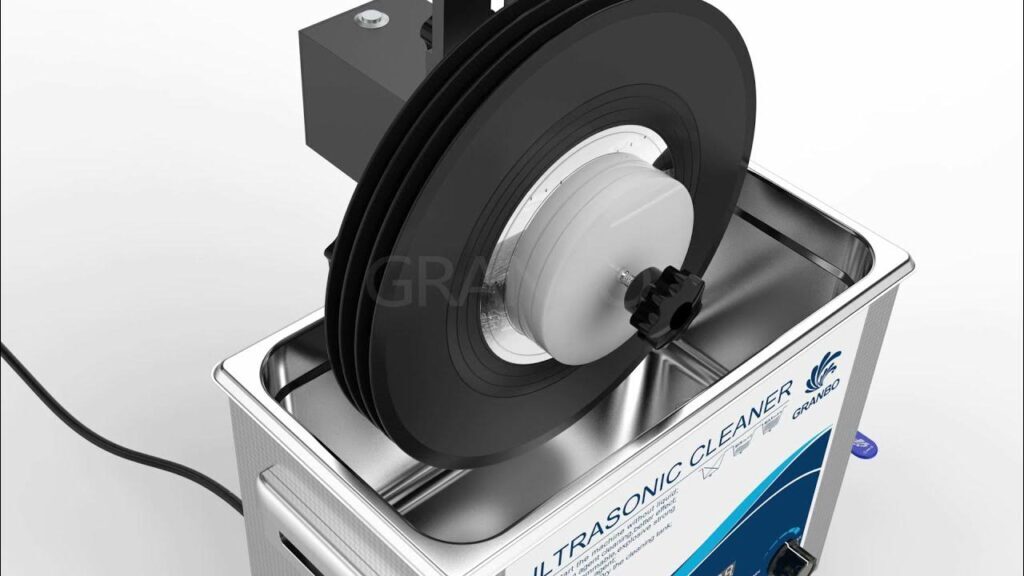
Vinyl Records Ultrasonic Cleaner
Pre-Cleaning Inspection
Inspect each record before cleaning. Check for cracks, warping, deep scratches, delamination, label damage, mold, and visible residue. A severely warped record may not rotate correctly and may contact the tank, spindle, or adjacent records.
Remove loose dust with a carbon-fiber brush, air blower, or another method recommended for record care. The Library of Congress recommends using canned air to remove dust from grooved discs, including vinyl records. See Care, Handling, and Storage of Audio Visual Materials – Collections Care (Library of Congress).
Do not use compressed air that contains oil or moisture. Air pressure should not force particles deeper into the groove or spread mold contamination to nearby records.
Water, Cleaning Fluid, and Degassing
Use distilled or deionized water when the system manufacturer recommends it or when mineral residue must be minimized. Tap water may leave deposits and is less suitable for a final record-cleaning bath unless the water quality and rinse process are controlled.
Add only a record-safe cleaning concentrate at the specified dosage. The solution should be low-foaming and designed to rinse clean. Excessive surfactant can make the record difficult to dry and may leave a residue that affects playback.
Freshly prepared water contains dissolved gases that can reduce ultrasonic performance at the beginning of a cycle. Use the cleaner’s degas function or follow its operating instructions before loading records. Some record-cleaning systems provide separate pulse or degas controls. See STEP 2 RECORD CLEANING AND RESTORATION (KirmussAudio).
Record Spacing, Rotation, and Cycle Time
Mount the records with appropriate spacers so that liquid can reach the playing surfaces. Keep the labels above the liquid when required by the machine design. Do not allow the records to touch the tank bottom or one another.
Set the cleaning time according to the machine and fluid instructions. A longer cycle does not automatically provide better results. Excessive exposure can increase bath temperature, fluid contamination, static, and drying time.
Monitor the bath during operation. Excessive foam, unusual noise, record movement, label wetting, or visible surface residue indicates that the process should be stopped and checked.
Rinsing and Drying
Rinsing is important when the cleaning bath contains surfactants, dissolved soil, or other additives. A final rinse with clean distilled or deionized water can reduce residue and mineral deposits.
Dry records completely before placing them in sleeves. Air drying can reduce physical contact with the playing surface, but the drying environment must be clean and free from airborne dust. A record should not be stored while moisture remains in the grooves.
Use clean, antistatic inner sleeves after cleaning. Returning a clean record to a dusty or contaminated sleeve can reintroduce particles and reduce the benefit of the cleaning process.
Common Problems and Limitations
Dirty Bath Water and Redeposition
Ultrasonic cleaning transfers contamination from the record into the bath. If the water becomes saturated with dust, oil, mold residue, or cleaning-fluid contamination, particles may redeposit on later records.
Filtration can improve bath life by removing suspended particles. CleanerVinyl describes micron filtration as a way to remove dirt during ultrasonic cleaning and reduce redeposition. See FAQs (CleanerVinyl).
Filtration does not replace solution replacement. Dissolved oils, surfactants, and chemical contaminants may remain in the water even after visible particles have been removed. The bath should be changed according to the equipment instructions, contamination level, and number of records processed.
Label and Vinyl Protection
Paper labels can be damaged by water, detergent, prolonged exposure, or poor sealing. The record-cleaning system should keep labels above the liquid or use a sealing method designed for the equipment.
Vinyl records can also warp if exposed to excessive heat or uneven heating. Temperature control is therefore important. A record-cleaning bath should not be allowed to reach a temperature that risks changing the record’s shape.
Record spacers, clamps, and spindle components should be made from materials that do not scratch the record or transfer residue. The equipment should be checked for sharp edges and misalignment before processing valuable records.
Residue, Static, and Incomplete Drying
A record may sound worse after cleaning if surfactant residue remains in the groove or if dissolved particles dry on the surface. This can produce clicks, a dull appearance, or a change in stylus behavior.
Static can also attract dust after cleaning. The cleaning fluid, drying environment, record sleeve, and handling method all affect static performance. CleanerVinyl identifies air drying as a method that avoids physical wiping and may reduce the introduction of new contamination. See FAQs (CleanerVinyl).
If residue remains, use a clean-water rinse and confirm that the cleaning concentrate is being dosed correctly. Do not assume that adding more fluid will improve cleaning.
Warped or Damaged Records
Ultrasonic cleaning cannot repair a warped record, damaged groove, delamination, or pressing defect. A warped record may also be unsafe to process if it cannot rotate without contacting the machine or neighboring records.
Records with severe mold, brittle surfaces, or unknown chemical contamination may require specialist handling. Preservation work should prioritize preventing contamination from spreading and avoiding irreversible surface damage.
Ultrasonic Cleaning Compared with Manual and Vacuum Cleaning
Manual cleaning is useful for removing loose dust, fingerprints, and light surface contamination. It requires less equipment and allows direct control over pressure, liquid volume, and contact area. However, a brush cannot always reach the full depth of every groove, and excessive brushing may move abrasive particles across the record surface.
Vacuum record-cleaning machines remove liquid and suspended contamination through a vacuum wand or slot. They can provide controlled fluid removal and are useful for pre-cleaning or final cleaning. Their effectiveness depends on brush contact, vacuum coverage, fluid chemistry, and the condition of the vacuum surface.
Ultrasonic record cleaners use acoustic cavitation to provide liquid-based cleaning across the immersed groove surface. They can process multiple records in a batch, but they require careful control of record spacing, labels, water quality, filtration, drying, and bath contamination.
A combined process may be appropriate. A manual or vacuum pre-clean can remove heavy contamination, followed by ultrasonic cleaning for groove access and a purified-water rinse for residue control. The exact workflow should follow the equipment and cleaning-fluid instructions.
References
- Sound Preservation at the Library of Congress | National Recording Preservation Plan | Programs (Library of Congress)
- Care, Handling, and Storage of Audio Visual Materials – Collections Care (Library of Congress)
- Effect of Detergent, Temperature, and Solution Flow Rate on Ultrasonic Cleaning: A Case Study in the Jewelry Manufacturing Process (MDPI)
- Record Cleaner (Tri-Art Manufacturing)
- G•Sonic Ultrasonic Concentrate (GrooveWasher)
- FAQs (CleanerVinyl)
- STEP 2 RECORD CLEANING AND RESTORATION (KirmussAudio)