 Granbo Sonic











Do Ultrasonic Jewellery Cleaners Work?
Browse Volume:21 Classify:Support
Yes, ultrasonic jewellery cleaners work by using high-frequency sound waves to loosen dirt, oil, and deposits from jewellery surfaces and hard-to-reach areas. They are particularly effective for cleaning metal settings, ring baskets, chains, and the spaces beneath suitable gemstones.
However, an ultrasonic jewellery cleaner is not safe for every material or jewellery design. The vibration and cleaning solution may damage treated gemstones, porous materials, fragile settings, or stones that are already loose. The most accurate answer is that ultrasonic cleaners work well when the jewellery, gemstone treatment, cleaning solution, and machine settings are compatible.
The Gemological Institute of America explains that ultrasonic cleaners can remove dirt and debris from areas that are difficult to reach, but it also warns that not all gemstones and jewellery can be safely cleaned in an ultrasonic machine. (gia.edu)

Jewelry
Do Ultrasonic Jewellery Cleaners Work?
The Short Answer
Ultrasonic jewellery cleaners are effective for removing contamination that is attached to a surface but can be loosened through mechanical agitation. Typical contaminants include skin oil, dust, hand cream, soap residue, makeup, polishing compounds, and dirt accumulated around stone settings.
The process is especially useful for jewellery with narrow spaces. Dirt often collects beneath diamonds, between prongs, around the back of a setting, inside chain links, and near hinge or clasp mechanisms. These areas are difficult to clean thoroughly with a cloth alone.
Ultrasonic cleaning does not improve the quality of a gemstone, repair a damaged setting, remove scratches, or restore a coating that has already deteriorated. It is a cleaning process, not a repair or restoration process.
The technology is most reliable when used on durable, untreated materials with secure settings. If the gemstone history is unknown or the jewellery is valuable, antique, repaired, or visibly damaged, professional inspection should come before ultrasonic cleaning.
What Ultrasonic Cleaners Can Remove
A correctly selected ultrasonic cycle may help remove:
- Oils from skin and cosmetics
- Dust and loose particles
- Soap and lotion residue
- Dirt beneath gemstones
- Deposits inside chain links
- Debris around prongs and bezels
- Light polishing or workshop residue
Ultrasonic cleaning is often more effective than manual wiping for three-dimensional jewellery because the liquid can reach surfaces that are hidden from direct contact. A ring may appear clean on its upper surface while retaining substantial residue under the centre stone. Cavitation and liquid movement help expose those areas to the cleaning solution.
The result still depends on the condition of the contamination. Hardened deposits, corrosion, permanent discoloration, and material embedded in surface fractures may not be removed completely. Repeated cleaning cycles should not be used as a substitute for professional examination when the jewellery remains visibly contaminated.
Why Results Depend on the Jewellery
Jewellery is a combination of materials and components rather than a single uniform object. A ring may contain gold, solder, a gemstone, a coating, a setting, and an adhesive-mounted decorative element. Each part may respond differently to vibration, heat, and cleaning chemistry.
A durable diamond mounted securely in platinum is not equivalent to an emerald set in gold, even if both pieces are described as gemstone jewellery. The gemstone’s internal structure, treatment history, setting condition, and exposure to previous repairs all affect ultrasonic-cleaning suitability.
For this reason, a machine advertised as a jewellery cleaner should not be interpreted as being safe for all jewellery. Equipment selection must be based on the item being cleaned.
How Ultrasonic Jewellery Cleaners Work
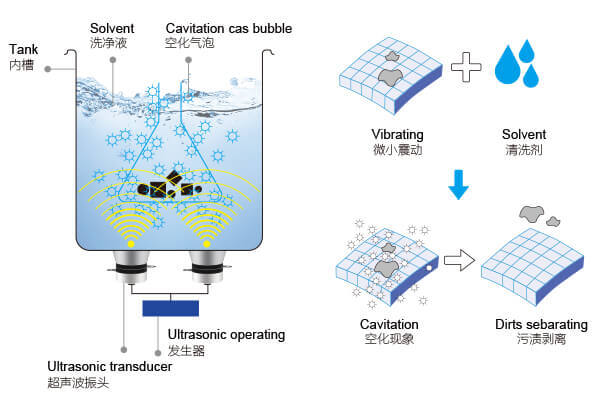
The Principle Behind Ultrasonic Cleaning
Cavitation and Acoustic Cleaning
An ultrasonic cleaner uses an electrical generator and transducers to introduce high-frequency mechanical vibration into water or another approved cleaning liquid. The sound waves create alternating pressure changes throughout the liquid.
When the pressure conditions are suitable, microscopic bubbles form and collapse. This process is called acoustic cavitation. The collapse of the bubbles produces local turbulence, liquid movement, and mechanical forces that help separate contamination from the jewellery surface.
The cleaning action is concentrated around surfaces exposed to the liquid. It can reach recessed areas beneath stones and between components, but it is not perfectly uniform throughout the tank. Jewellery placed directly against the tank wall or bottom may experience a different acoustic condition from jewellery suspended in the active cleaning zone.
Cavitation is not the same as sterilization. Ultrasonic cleaning may remove some surface contamination, but it does not guarantee the elimination of every microorganism or make jewellery medically sterile.
The Role of Frequency, Power, and Solution
Frequency influences cavitation behaviour. Many compact ultrasonic cleaners operate in the general range used for delicate parts cleaning, often around several tens of kilohertz. Lower frequencies may produce stronger and more aggressive bubble activity, while higher frequencies may create smaller bubbles and a gentler cleaning effect.
Frequency alone does not determine performance. Acoustic power density, transducer placement, tank geometry, liquid depth, temperature, and cleaning time also influence the process. A machine with a high advertised wattage is not necessarily better for delicate jewellery.
The cleaning solution also matters. Water provides the liquid medium required for cavitation, while a compatible low-foaming detergent can help loosen oils and organic deposits. Excessive foam can interfere with acoustic transmission and reduce cleaning consistency.
Household bleach, abrasive powders, strong solvents, and unapproved chemicals should not be added to a jewellery cleaner. They may damage metals, gemstones, coatings, seals, or the machine itself. The solution should be selected according to the equipment instructions and the jewellery manufacturer’s recommendations.
Tank Design and Loading
A well-designed ultrasonic jewellery cleaner should provide stable transducer mounting, a smooth tank interior, a clearly marked fill level, automatic cycle control, and a basket that prevents direct contact between jewellery and the tank surface.
Jewellery should be placed loosely in the basket. Pieces should not be stacked because one item can shield another from the ultrasonic field. Chains should be arranged so that they do not become tightly tangled, and earrings or small components should be secured to prevent loss during transfer.
Overloading the tank can reduce liquid circulation and create uneven cleaning. It may also cause jewellery pieces to strike one another, producing scratches or mechanical damage. The quantity and size of the load should remain within the equipment manufacturer’s stated limits.
Which Jewellery Is Suitable for Ultrasonic Cleaning?
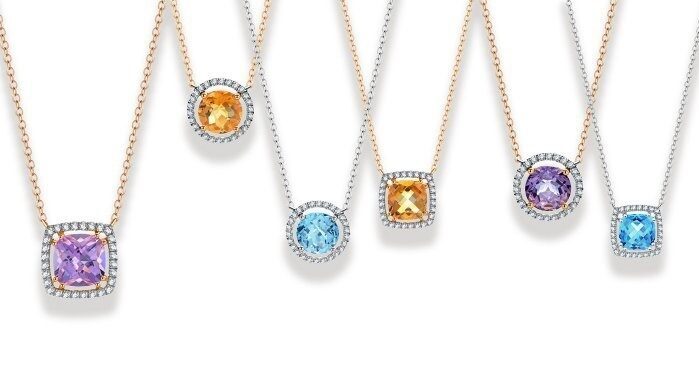
jewelry cleaner
Gold, Platinum, and Untreated Diamonds
Solid gold and platinum jewellery are often suitable for ultrasonic cleaning when the gemstone is compatible and the setting is secure. Untreated diamonds are generally durable enough for ultrasonic cleaning, although inclusions, fractures, setting condition, and stone-to-stone contact still require attention.
The Gemological Institute of America notes that diamonds are usually durable enough for ultrasonic cleaning, but treated or heavily included diamonds may require a gentler method. It also advises that jewellery settings should be inspected because vibration can loosen stones or chip diamonds that are positioned close together. (gia.edu)
A secure gemstone does not mean that every ultrasonic cycle is appropriate. Prongs may be worn, solder joints may be weakened, and older settings may contain hidden damage. A professional jeweller should inspect valuable or frequently worn pieces at suitable intervals.
Gemstones That Require Caution
Some gemstones can tolerate ultrasonic cleaning under controlled conditions, while others should only be cleaned using warm water, mild soap, and a soft brush. The gemstone type alone may not be enough to determine the correct method because treatments and internal characteristics also matter.
Gemstones that commonly require caution include:
- Emerald
- Opal
- Tanzanite
- Turquoise
- Lapis lazuli
- Malachite
- Moonstone
- Sunstone
- Fluorite
- Iolite
- Kunzite
- Topaz
- Zircon
- Peridot
This list is not exhaustive. GIA specifically advises against ultrasonic cleaning for gemstones with surface-reaching fractures filled with oil, resin, or glass-like materials; organic gem materials; coated stones; and various gemstones that are vulnerable to heat or temperature changes. (gia.edu)
Pearls, Opals, Emeralds, and Organic Materials
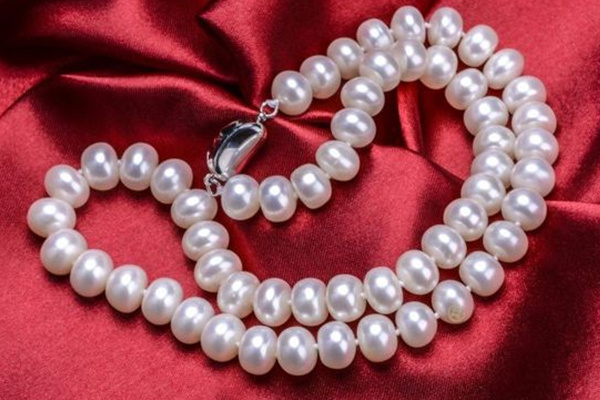
pearl
Pearls, coral, amber, ivory, shell, and other organic or porous materials should generally not be placed in an ultrasonic cleaner. They may absorb cleaning liquid, respond poorly to heat, or suffer damage from vibration and chemical exposure.
Opals and some other gemstones may contain internal structures or water-related characteristics that make them vulnerable to thermal or mechanical stress. Emeralds are frequently treated with oil, resin, or other substances to improve apparent clarity. Ultrasonic energy may affect those treatments or enlarge existing fractures.
The safest approach for these materials is gentle cleaning with warm water, mild soap where appropriate, a soft brush or cloth, and careful drying. GIA identifies warm, soapy water and soft brushing as safer methods for many sensitive gemstones. (gia.edu)
When Should Ultrasonic Jewellery Cleaners Not Be Used?
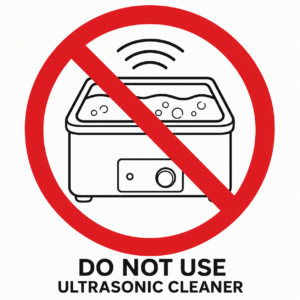
Do Not Use
Treated or Fracture-Filled Stones
Gemstone treatments are a major factor in ultrasonic-cleaning decisions. Fracture filling, oiling, resin filling, waxing, dyeing, coating, and certain colour treatments may not be permanent or may require special care.
Fracture-filled diamonds are a particularly important example. The filling material may degrade, become discoloured, or be affected by ultrasonic cleaning, heat, or certain chemicals. GIA has reported that fracture-filling treatments are not permanent and require special care. (gia.edu)
The Federal Trade Commission also advises that consumers should be informed when gemstone treatments require special care, including situations where ultrasonic cleaners or solvents should be avoided. (ftc.gov)
If the treatment history is unknown, the jewellery should not be placed in an ultrasonic machine until the stone has been identified and assessed.
Loose, Damaged, or Antique Jewellery
Ultrasonic cleaning should not be used on jewellery with loose stones, broken prongs, cracked settings, damaged clasps, loose enamel, or visible structural weakness. Vibration can worsen an existing defect or cause a stone to fall out during the cycle.
Antique and estate jewellery require additional caution because the construction may include aged solder, thin metal sections, fragile settings, or previous repairs. The piece may look intact while having reduced mechanical strength.
A quick visual inspection is useful, but it does not replace a professional setting check. If a stone moves when gently touched, the jewellery should be repaired before cleaning.
Delicate Settings and Mixed-Material Pieces
Ultrasonic cleaning may be unsuitable for jewellery that includes glued components, soft stones, enamel, wood, leather, textile elements, hollow structures, or mixed materials with different expansion behaviour.
Pieces with stones set close together may also be at risk of contact damage. GIA warns that vibration can chip gemstones when their girdles touch. (4cs.gia.edu)
When a piece contains several different materials, the most sensitive component should determine the cleaning method.
How to Use an Ultrasonic Jewellery Cleaner Correctly
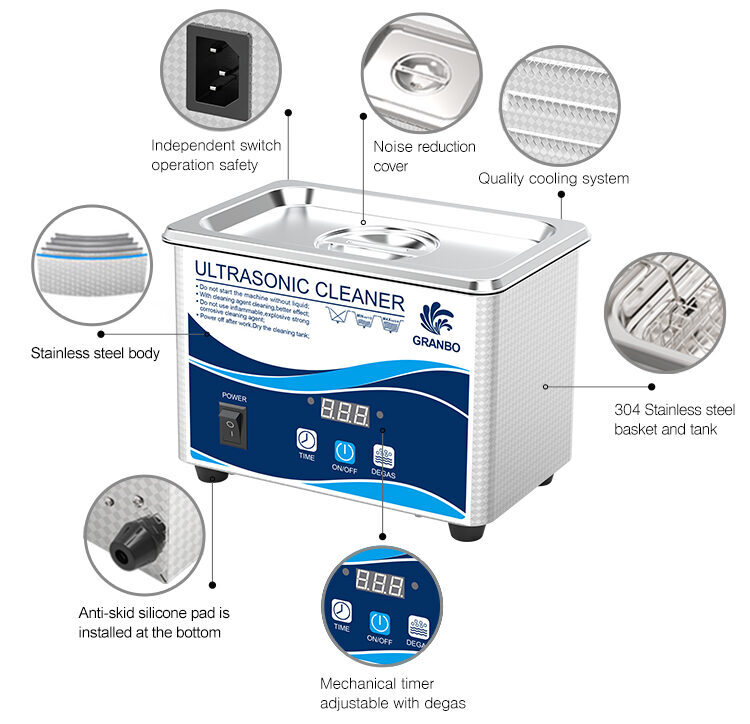
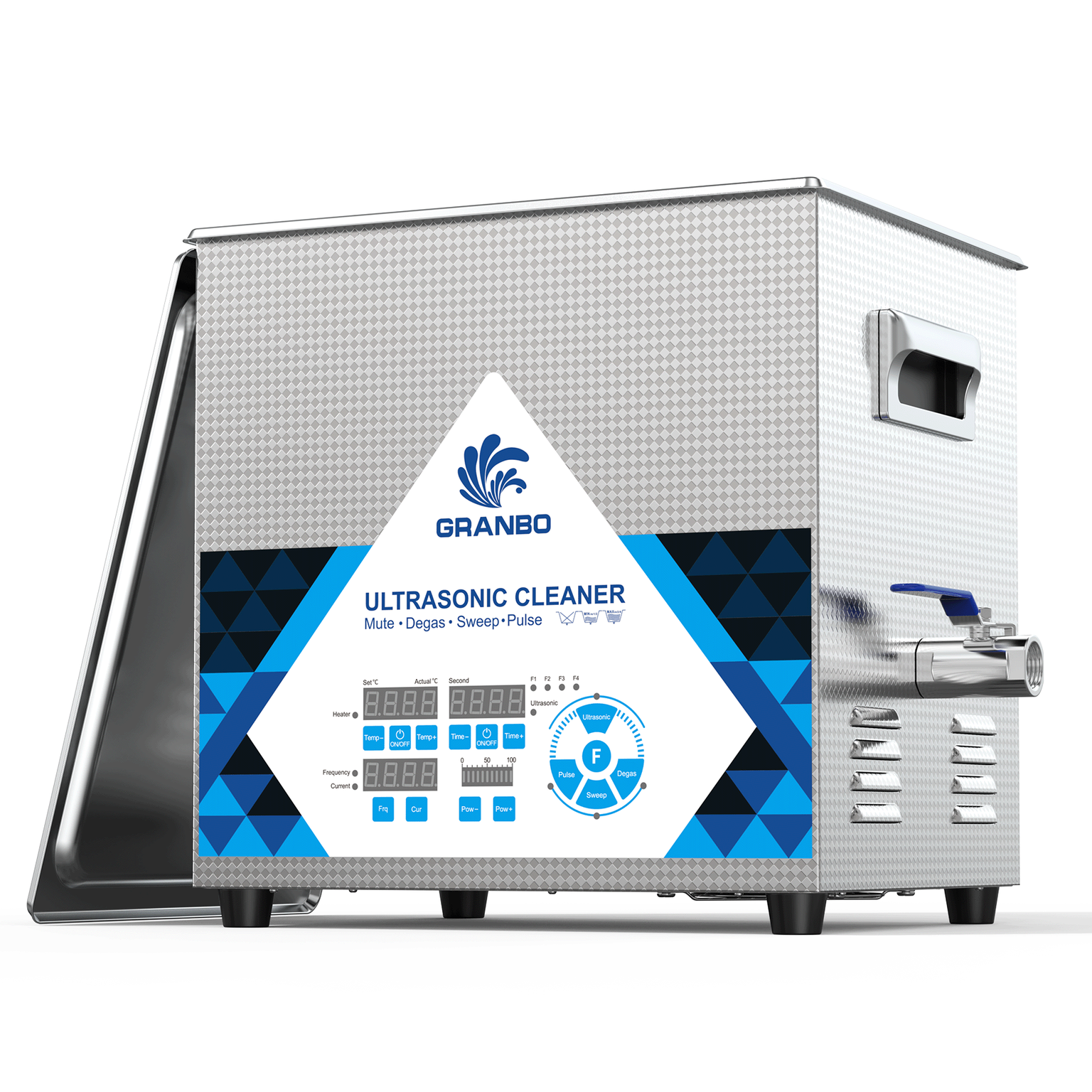
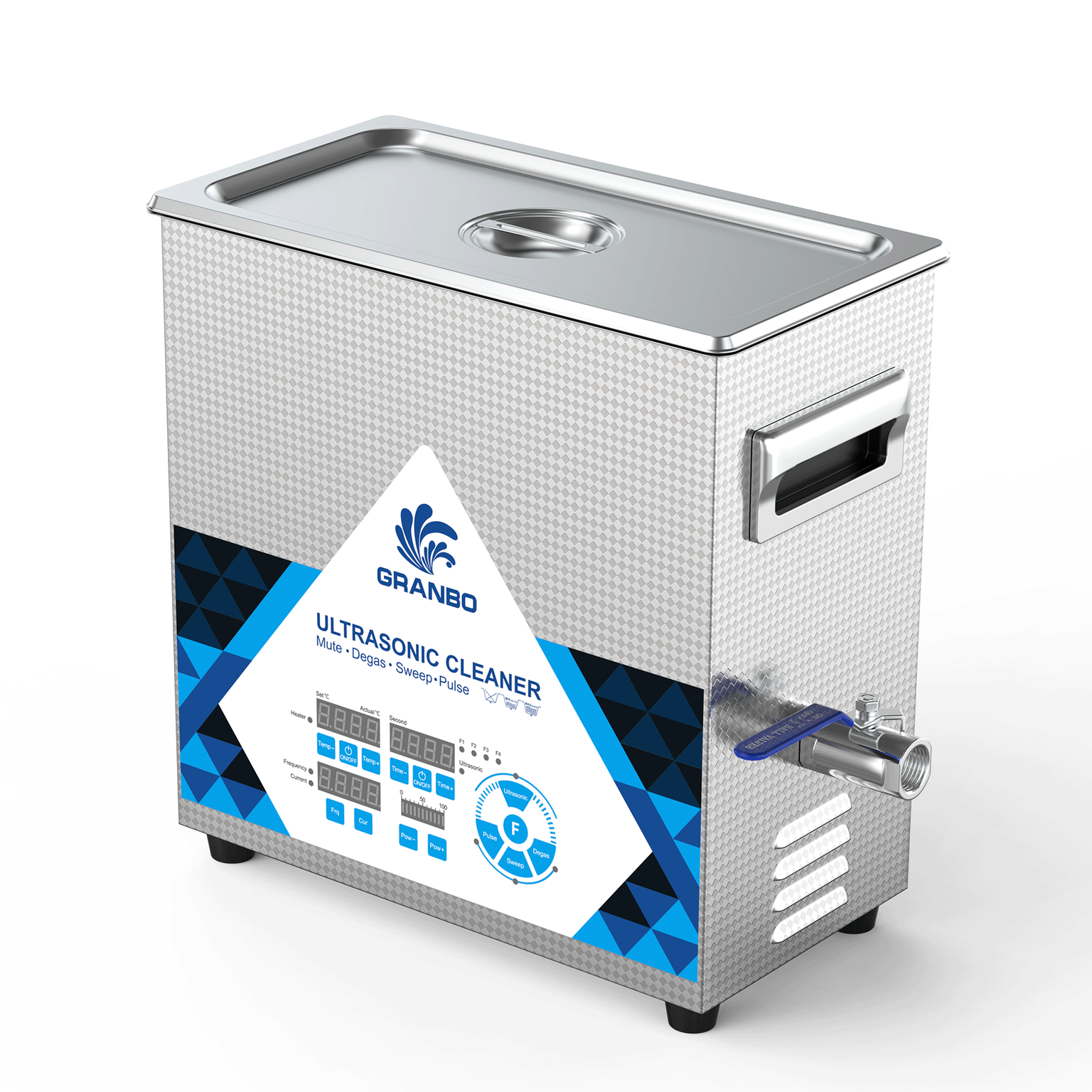
Granbo GA008G Jewelry Ultrasonic Cleaner
Inspecting Jewellery Before Cleaning
Before cleaning, identify the metal, gemstones, treatments, and construction method as far as possible. Check the jewellery for loose stones, worn prongs, cracks, damaged clasps, peeling coatings, or attached components that may detach.
If the jewellery has a gemological report, manufacturer care instructions, or treatment disclosure, review the information before selecting an ultrasonic cycle. The presence of an untreated diamond does not make a ring safe if the ring also contains an ultrasonic-sensitive gemstone or a fragile setting.
Jewellery with unknown stones should be treated conservatively. A professional jeweller or gemologist can identify the materials and recommend a suitable cleaning method.
Selecting Water and Cleaning Solution
Use clean water and a jewellery-cleaning solution specifically approved for ultrasonic equipment. A low-foaming formulation is preferred because stable foam can reduce cavitation and make the cleaning process less consistent.
The concentration should be measured according to the solution instructions. Adding more detergent does not necessarily improve cleaning and may increase residue, foaming, corrosion, or material exposure.
Do not use bleach, abrasive products, toothpaste, acetone, or aggressive household chemicals. GIA warns that chlorine and abrasive cleaners can damage jewellery metals and settings. (4cs.gia.edu)
Loading and Operating the Machine
Fill the tank to the indicated level and allow the equipment to operate with sufficient liquid. Jewellery should be placed in a basket or holder rather than directly on the tank bottom.
Use a short, controlled cycle at the recommended temperature. Longer treatment may increase heat and mechanical exposure without producing a proportional cleaning benefit. Delicate items should receive the least aggressive validated cycle.
Avoid placing hands in the tank while the ultrasonic generator is operating. Follow the equipment’s electrical, temperature, ventilation, and handling instructions.
Rinsing, Drying, and Post-Cleaning Inspection
After cleaning, remove the jewellery carefully over a secure work surface. Rinse it with clean water to remove loosened particles and cleaning-solution residue. A container of water is safer than rinsing directly over an open sink because a loose stone or complete piece of jewellery could be lost down the drain. GIA recommends taking precautions around sinks and using a secure rinsing method. (gia.edu)
Dry the piece with a soft, lint-free cloth and inspect the stones and settings again. Check that prongs, clasps, and small components remain secure. If a stone has moved or the jewellery appears damaged, stop using it until it has been examined.
Advantages and Limitations of Ultrasonic Jewellery Cleaning
The main advantage of ultrasonic cleaning is access. The liquid can reach areas that are difficult to contact with a cloth or brush, including the back of settings, narrow grooves, chain links, and hinge mechanisms.
Ultrasonic cleaning can also reduce manual brushing, which may be useful for jewellery with complex shapes. A controlled machine cycle can provide more repeatable cleaning than casual soaking, provided that the load and solution are properly managed.
The limitations are equally important. Ultrasonic cleaning cannot identify gemstone treatments, confirm structural integrity, repair loose settings, or guarantee that a gemstone will tolerate vibration. It may also cause damage when the jewellery is incorrectly identified or already compromised.
The machine should therefore be considered a specialised cleaning tool rather than a universal jewellery-care solution.
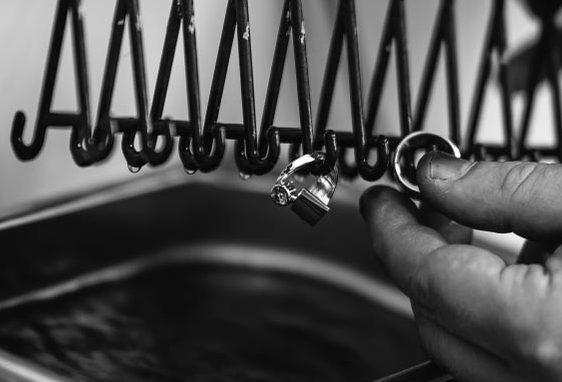
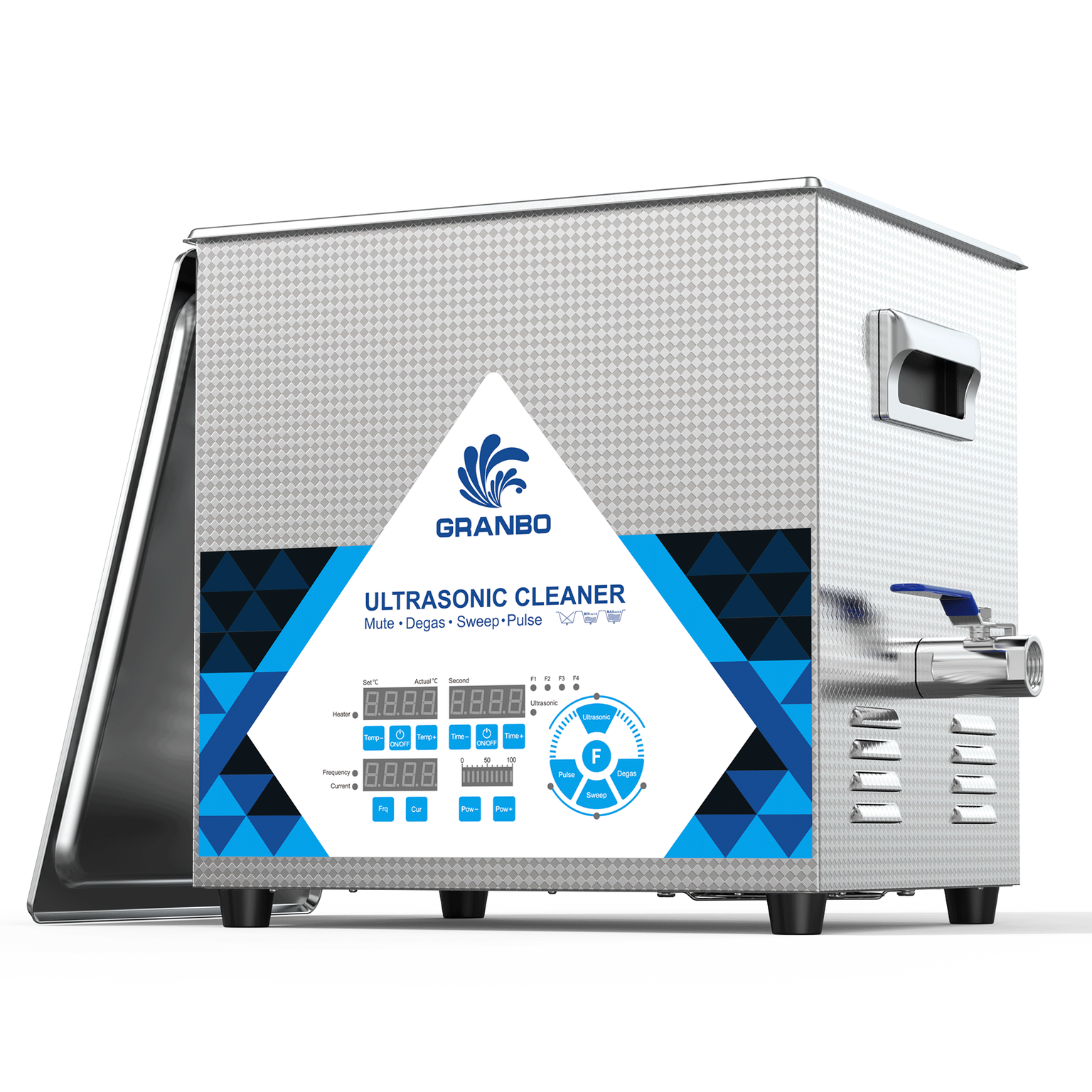
Granbo Ultrasonic Jewelry Cleaning
Common Problems and Troubleshooting
Jewellery Still Looks Cloudy
Cloudiness may be caused by remaining oil, mineral deposits, dried cleaning solution, surface damage, or a deteriorated coating. Replace the contaminated bath, rinse the jewellery, and inspect it under good lighting.
If the haze remains after proper rinsing, additional ultrasonic cycles may not help. The problem may require professional polishing, coating assessment, or gemstone inspection.
Stones Become Loose
A loose stone after cleaning may indicate a pre-existing setting problem rather than a defect caused entirely by the machine. Ultrasonic vibration can expose weaknesses in worn prongs, bezels, or other mounting components.
Do not continue cleaning the piece. Place it in a secure container and arrange a professional inspection.
Surface Damage or Discoloration
Discoloration may result from a gemstone treatment, dye, coating, chemical incompatibility, or excessive heat. Porous and treated stones are especially vulnerable.
The jewellery should be removed from further chemical exposure and assessed by a qualified jeweller or gemologist.
Uneven Cleaning
Uneven cleaning can be caused by overloading, poor positioning, insufficient liquid, weak acoustic coverage, or heavy contamination. Repositioning may improve access, but repeatedly increasing the cycle time is not always an appropriate solution.
Professional equipment may use baskets, fixtures, circulation, filtration, and validated loading patterns to improve consistency.
Ultrasonic Cleaning Compared with Manual Cleaning
Granbo ultrasonic Jewelry Cleaning
Manual cleaning with warm water, mild soap, and a soft brush is suitable for many jewellery items and is often the safer choice for sensitive gemstones. It provides direct control over the amount of mechanical force and makes it easier to avoid fragile areas.
Ultrasonic cleaning offers a stronger advantage when dirt is concentrated in inaccessible recesses. It may be appropriate for selected gold, platinum, and untreated diamond jewellery with secure settings.
The safest cleaning method depends on the weakest or most sensitive part of the piece. When gemstone treatment, setting condition, or material identity is uncertain, gentle manual cleaning or professional service is preferable.
Practical Buying and Maintenance Considerations
A jewellery ultrasonic cleaner should be evaluated by more than tank capacity or advertised frequency. Important design features include:
- Stable acoustic output
- Smooth, corrosion-resistant tank construction
- Low-foaming solution compatibility
- Clearly marked water levels
- Controlled cycle duration
- Temperature monitoring or limitation
- A protective basket or support
- Easy drainage and tank cleaning
- Overheat and dry-run protection
- Clear instructions for prohibited materials
The tank should be emptied, rinsed, and dried after each use. Cleaning residue and metal particles can contaminate later loads and may affect the tank or jewellery. The basket should also be cleaned regularly because trapped particles can scratch delicate pieces.
The equipment should be inspected for unusual noise, heating, leaks, damaged cables, or reduced cleaning performance. A machine that produces inconsistent cavitation or excessive heat should be removed from service until the cause is identified.
Final Recommendation
Do ultrasonic jewellery cleaners work? Yes. They can effectively remove oil, dirt, and deposits from suitable jewellery, especially around settings, chains, hinges, and other hard-to-reach areas.
They should not be used as a universal cleaner for every gemstone or jewellery design. Pearls, coral, amber, ivory, opal, turquoise, many treated stones, fracture-filled diamonds, fragile settings, and jewellery with unknown condition require caution or an alternative cleaning method. GIA recommends using ultrasonic cleaners carefully and choosing professional cleaning when gemstone durability or treatment history is uncertain. (gia.edu)
For routine care, warm water, mild soap, a soft brush, and a lint-free cloth are suitable for many pieces. An ultrasonic jewellery cleaner is most valuable when the item is correctly identified, structurally sound, and compatible with the selected cleaning process.