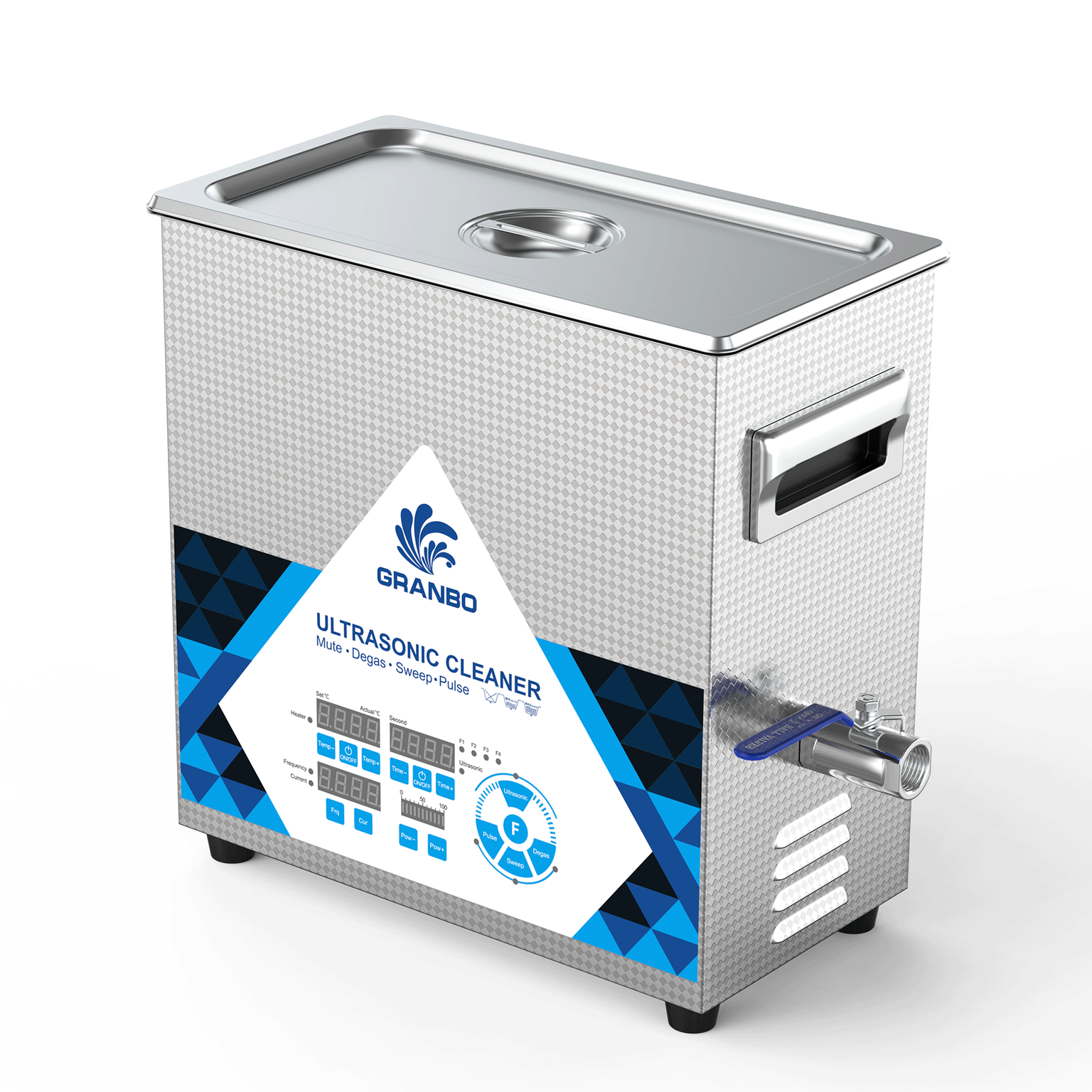
 Granbo Sonic












Do Ultrasonic Glasses Cleaners Work?
Browse Volume:14 Classify:Support
Yes, ultrasonic glasses cleaners are highly effective, particularly at removing oil, dust, skin residue, makeup, and debris from hard-to-reach areas like frames, nose pads, and hinges. They rely on ultrasonic cavitation—a process in which high-frequency sound waves generate microscopic bubbles in liquid. As these bubbles implode, they rapidly loosen dirt and grime from immersed surfaces.
However, ultrasonic cleaners are not universally safe for all eyewear. Prescription lenses often feature delicate coatings, such as anti-reflective, scratch-resistant, oleophobic, UV, or mirror finishes, which can be damaged during the process. While some manufacturers permit professional ultrasonic cleaning, others advise using only lens-safe sprays, lukewarm water, and microfiber cloths. For example, ZEISS states that ultrasonic cleaning is suitable for frames only when performed by an eye-care professional after the lenses have been removed. (zeiss.com)
Ultimately, whether an ultrasonic cleaner is right for you depends on compatibility: while these devices can clean effectively, the machine, liquid, cycle length, and lens condition must all align with your specific eyewear. A cleaner that safely restores a metal frame might still damage coated lenses or fragile frame components.
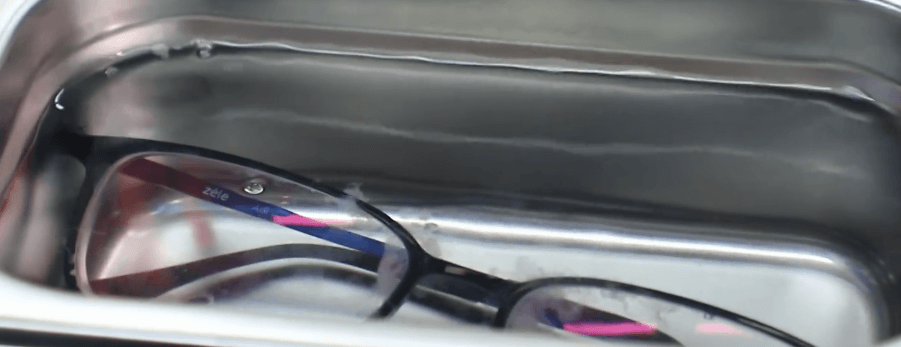
The glasses are undergoing cleaning in the ultrasonic cleaner
Do Ultrasonic Glasses Cleaners Work?
The Short Answer
Ultrasonic glasses cleaners do work as a method of immersed mechanical cleaning, but they are most reliable for frames and hard-to-reach components. They can loosen oils and debris around hinges, nose pads, temple arms, bridge areas, and frame grooves. They may also clean the external surfaces of lenses, but the suitability of that process depends on the lens material, coating condition, frame construction, and equipment settings.
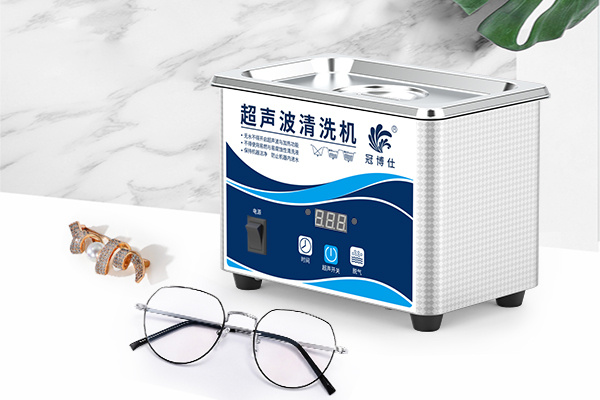
Granbo GA008 Ultrasonic Eyeglass Cleaner
The cleaning result is influenced by more than the advertised ultrasonic frequency. Tank geometry, transducer placement, acoustic power, water level, temperature, solution chemistry, loading position, and cycle duration all affect how evenly cavitation reaches the glasses.
A small consumer cleaner may produce acceptable results for basic metal frames and durable eyewear, but it should not be assumed to match the controlled process used in an optical laboratory or professional eyewear workshop. Professional systems may use validated cleaning solutions, controlled loading fixtures, adjustable power, and inspection procedures.
What Ultrasonic Cleaning Can Remove
Ultrasonic cleaning is effective mainly against contamination that is attached to the surface but can be mechanically loosened. Common examples include:
- Skin oil and sebum
- Dust and fine particles
- Makeup residue
- Dried perspiration
- Food particles
- Debris around hinges and nose pads
- Deposits in frame grooves and screw areas
The process can be especially useful where a cloth cannot reach. Nose-pad brackets, spring hinges, bridge joints, and narrow spaces around the frame may retain residue even when the lenses appear clean.
Ultrasonic cleaning does not repair scratches, remove permanent coating damage, restore discolored plastic, or correct a loose hinge. It also cannot remove contamination that has penetrated a damaged coating or entered a sealed component.
Why Results Vary
Two ultrasonic cleaners with the same advertised frequency may deliver different cleaning results. A typical consumer machine may operate near 40 kHz, a common range for general-purpose cleaning, but frequency alone does not describe the actual acoustic field.
The transducers must be properly matched to the tank, and the tank must provide reasonably uniform energy distribution. If cavitation is concentrated in one area, parts of the frame may be cleaned thoroughly while other areas remain contaminated.
Loading also affects performance. Glasses that touch the tank bottom, rest against the sidewall, or are placed directly on top of another pair may experience uneven cleaning. A suitable basket or support should hold the glasses away from the tank surface while allowing water to contact the frame.
How Ultrasonic Glasses Cleaners Work

The Principle Behind Ultrasonic Cleaning
Cavitation and Acoustic Streaming
An ultrasonic cleaner contains an electrical generator and one or more transducers. The generator supplies a high-frequency signal, and the transducers convert that signal into mechanical vibration in the cleaning liquid.
As sound waves move through the water, they create alternating high-pressure and low-pressure cycles. Under suitable conditions, microscopic bubbles form and collapse. This is known as acoustic cavitation. The collapse of the bubbles produces local liquid movement, turbulence, and shear forces that disturb particles attached to the glasses.
Acoustic streaming also moves the liquid around the frame. This improves contact with curved surfaces and narrow gaps that may not be reached by direct wiping. The action is mechanical rather than a process of “pulling” dirt out through the lens.
The intensity of cavitation must be controlled. Higher power is not always better for eyewear. Excessive acoustic energy can increase the risk of damage to weak coatings, loose components, delicate finishes, or aged plastics.
The Role of Water and Cleaning Solution
Water is the usual base liquid for consumer ultrasonic glasses cleaners. A small amount of a low-foaming, neutral cleaning solution may be permitted if the machine and the eyewear manufacturer allow it.
Household detergents, bleach, ammonia, alcohol, mouthwash, jewelry solutions, and other chemicals should not be added automatically. Some chemicals can leave residue, attack coatings, discolor frame finishes, or create excessive foam.
Foam is particularly undesirable because it interferes with the transmission of ultrasonic energy. A solution that produces a thick layer of stable bubbles may reduce cleaning consistency even though the liquid appears highly active.
For coated lenses, a lens-cleaning spray or pre-moistened wipe designed for optical surfaces is often a lower-risk option. ZEISS identifies lens wipes and lens sprays as products designed for coated optical surfaces and recommends applying cleaning spray to the cloth rather than directly to glasses with openings or drilled frame areas. (zeiss.com)
Frequency, Power, and Tank Design
Frequency affects the size and behavior of cavitation bubbles. Lower frequencies can produce more energetic cleaning action, while higher frequencies generally create smaller bubbles and may be better suited to delicate parts. This is a general engineering relationship, not a guarantee of safety.
Power density is also important. It describes how much acoustic energy is delivered to a given liquid volume. A small tank with high power density may create a more aggressive process than a larger tank with the same nominal wattage.
A well-designed glasses cleaner should provide stable power, a clearly marked fill level, automatic cycle control, and a basket that prevents the glasses from contacting the tank. Temperature control is also useful because excessive heat can affect plastic lenses, coatings, adhesives, and frame materials.
What Parts of Glasses Can Be Cleaned?
Miniature figure cleaning the lens of a pair of gold-rimmed eyeglasses
Frames, Nose Pads, and Hinges
Frames are usually the most suitable part of glasses for ultrasonic cleaning. Metal frames, many rigid plastic frames, nose pads, hinge areas, and temple arms can collect oils and debris in recessed locations.
The process is particularly useful for professional optical workshops because it can clean many small frame surfaces at once. However, the frame material still matters. Painted finishes, soft-touch coatings, glued decorations, plated surfaces, and aging plastics may not tolerate repeated exposure to ultrasonic energy or cleaning chemicals.
Spring hinges and small screws should also be inspected after cleaning. Ultrasonic treatment may remove dirt that was concealing wear or corrosion, but it cannot replace damaged hardware.
Glass and Plastic Lenses
Lenses may be made from mineral glass, polycarbonate, high-index plastic, or other optical materials. They may also include multiple thin-film coatings. The base lens material can be resistant to water and mild cleaning solutions while the coating system remains more sensitive to heat, chemicals, and mechanical stress.
Some optical cleaning studies have examined ultrasonic cleaning of glass parts, showing that ultrasound can be used as part of controlled optical-glass cleaning processes. Industrial optical cleaning, however, uses specified equipment, process chemistry, and inspection controls that may not be present in a household device. (jstage.jst.go.jp)
The difference between cleaning bare optical glass and cleaning finished prescription lenses is significant. Prescription lenses may include bonded or deposited coatings that must remain uniform across the surface.
Coatings, Adhesives, and Rimless Frames
Lens coatings can include hard coats, anti-reflective layers, water-repellent layers, UV treatments, mirror coatings, and other surface technologies. These layers improve performance, but they add interfaces that may be affected by repeated thermal or chemical exposure.
A technical document submitted to the FDA for a coated lens product warns that excessive cleaning may wear down the coating. This does not establish that every ultrasonic cycle will cause damage, but it demonstrates why coating condition and cleaning frequency must be considered. (accessdata.fda.gov)
Rimless and semi-rimless glasses require additional caution. Their lenses may contain drilled holes, compression fittings, nylon cord, screws, or adhesive-mounted components. Ultrasonic energy and liquid movement may expose weak points that are not present in full-rim frames.
Are Ultrasonic Cleaners Safe for Eyeglasses?
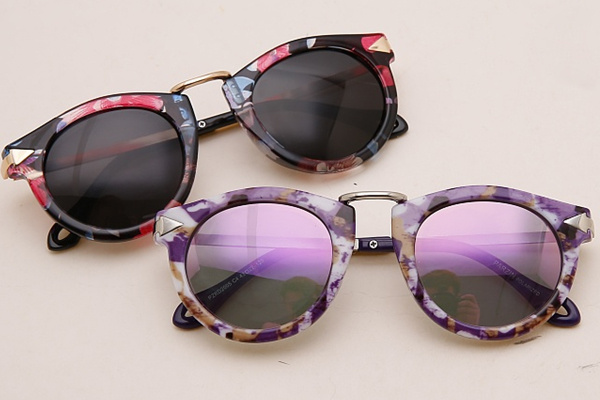
Lens Coating Risks
The greatest concern is usually not the lens substrate itself but the coating system. Coating damage may appear as:
- Hazy or cloudy areas
- Peeling or delamination
- Fine cracks or “crazing”
- Irregular color reflections
- Persistent streaking
- Areas that no longer wet evenly
- A rough or patchy surface
If a coating is already aged, cracked, or separating, ultrasonic cleaning may accelerate visible failure. The machine may not be the original cause, but the cleaning process can expose an existing weakness.
ZEISS specifically advises that consumers should not place glasses into a jewelry ultrasonic cleaner and recommends that an eye-care professional handle ultrasonic cleaning, with the lenses removed first. (zeiss.com) This is a strong indication that consumer machines should not be used without checking the lens and frame manufacturer’s guidance.
Frame and Component Risks
A frame can be damaged by more than cavitation. High temperature, aggressive chemicals, repeated immersion, and impact against the tank or basket may affect the frame.
Possible problems include loosened nose pads, weakened adhesives, loss of decorative finishes, discoloration of plastic, corrosion of hinge components, and movement of small screws. These risks are greater for older or repaired glasses.
The glasses should never be allowed to rest directly on the tank bottom. Direct contact can create scratches, transmit stronger vibration into the frame, and produce uneven cleaning.
Why Professional Cleaning Is Different
Professional optical equipment is usually operated by personnel who can inspect the glasses before and after cleaning. The lenses may be removed when necessary, and the solution, temperature, cycle, and support fixtures can be selected according to the item.
An optical professional can also identify coating failure, loose screws, cracked frames, drilled lenses, and other conditions that are not obvious to a consumer. This is why professional ultrasonic cleaning is not equivalent to placing complete glasses into a general-purpose jewelry cleaner.
How to Use an Ultrasonic Glasses Cleaner Correctly
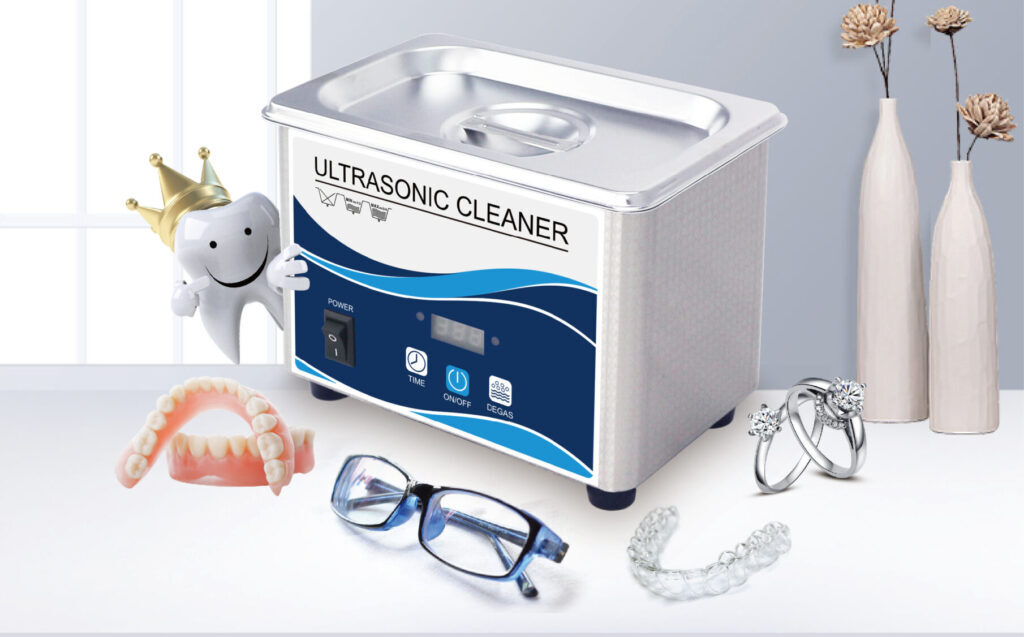
Granbo GA008 ultrasonic cleaner
Pre-Cleaning Inspection
Before starting, inspect the lenses and frame under good lighting. Do not use ultrasonic cleaning if the lenses show coating peeling, cracks, deep scratches, loosened edges, or visible separation.
Check the frame for loose screws, damaged nose pads, broken hinges, cracked temples, and decorative parts that may fall off. If the glasses are expensive, customized, rimless, or already damaged, professional cleaning is a more appropriate option.
Remove loose dust under lukewarm running water before placing the glasses in the tank. Dry wiping can drag abrasive particles across the lens and create micro-scratches. ZEISS advises against cleaning glasses with tissues or clothing for this reason. (zeiss.com)
Water, Detergent, and Loading
Use clean water at the temperature specified by the cleaner and eyewear manufacturer. Lukewarm water is generally preferred for consumer eyewear because very hot water can damage lenses, coatings, or plastic frames.
If a cleaning solution is permitted, use only a low-foaming product formulated for ultrasonic cleaning or optical components. The correct concentration should be measured rather than estimated.
Place the glasses in a support basket with the lenses and frame fully immersed. Avoid stacking multiple pairs. Keep the glasses away from the tank bottom and sidewalls, and ensure that air bubbles are not trapped under the nose pads or inside frame grooves.
Cycle Time and Temperature
A short, gentle cycle is preferable for delicate eyewear. Many consumer machines use a cycle of several minutes, but the correct time depends on the equipment and the condition of the glasses.
Longer treatment does not necessarily produce better cleaning. It may increase heat, chemical exposure, and mechanical stress. If the glasses are still dirty after a short cycle, manual cleaning or professional inspection is preferable to repeatedly increasing the ultrasonic time.
Rinsing and Drying
After the cycle, rinse the glasses with clean lukewarm water to remove loosened particles and cleaning-solution residue. Dry them with a clean lens-safe microfiber cloth or allow them to air-dry before gently wiping remaining water.
Do not use paper towels, tissues, shirt sleeves, or abrasive cloths. Small particles trapped in fabric can scratch optical surfaces. The cleaning cloth should also be washed regularly and stored in a clean location.
What Should Not Be Put in an Ultrasonic Glasses Cleaner?
Glasses with damaged or delaminating coatings should not be placed in an ultrasonic cleaner. The process may make the defect more visible or accelerate separation.
Contact lenses should not be cleaned in a general-purpose ultrasonic glasses cleaner. Contact-lens materials and approved care systems are different from eyeglass lenses, and improper cleaning can create an eye-safety risk.
Unapproved chemicals should also be avoided. In particular, do not add:
- Ammonia or strong alkaline cleaners
- Bleach or disinfectants
- Acetone or aggressive solvents
- Mouthwash
- High-alcohol mixtures
- Abrasive powders
- Jewelry cleaning chemicals unless specifically approved
The absence of visible damage after one cycle does not prove long-term compatibility. Repeated exposure may gradually change the coating, frame finish, or adhesive components.
Common Problems and Troubleshooting
Cloudy Lenses
Cloudiness may be caused by mineral deposits, residue, coating damage, or aging. If the haze remains after rinsing with clean water and using a lens-safe cleaner, the lens should be inspected by an optical professional.
Ultrasonic cleaning cannot reverse coating failure or remove scratches. Repeated cycles may make an existing problem worse.
Persistent Smears
Smears may result from oily contamination, dirty water, excess detergent, or a contaminated microfiber cloth. Replace the tank water and clean the cloth before increasing the cycle time.
If the surface remains uneven after cleaning, the issue may be related to the lens coating rather than removable dirt.
Loose Screws or Damaged Components
If a screw, nose pad, hinge, or decorative component becomes loose, stop using the cleaner for that pair. The glasses should be repaired and inspected before another cleaning cycle.
Uneven Cleaning
Uneven results may occur when the glasses touch the tank, are overloaded, or are positioned in a weak acoustic area. Repositioning may help, but inconsistent cleaning can also indicate poor transducer distribution or inadequate tank design.
Ultrasonic Cleaning Compared with Manual Cleaning
Manual cleaning remains the most practical routine method for most glasses. Lukewarm running water, a small amount of lens-safe or mild detergent where permitted, and a clean microfiber cloth can remove everyday oil and dust without exposing the glasses to ultrasonic energy.
Ultrasonic cleaning offers an advantage when contamination is concentrated in frame joints, nose-pad brackets, hinge areas, and other narrow spaces. It is less necessary when the main problem is fingerprints on the lens surface.
For daily care, a lens-safe wipe or spray may be more appropriate. ZEISS identifies its wipes and sprays as products designed for coated optical surfaces, while also recommending that users avoid aggressive glass-cleaning substances. (zeiss.com)
A professional optical cleaning service is preferable when the glasses have premium coatings, rimless construction, visible damage, unusual materials, or a high replacement cost.
Final Recommendation
Do ultrasonic glasses cleaners work? Yes. They can effectively loosen dirt, oil, makeup, and debris from frames and hard-to-reach components, and they may be useful for selected eyewear when the materials and coatings are compatible.
They are not automatically safe for every pair of prescription glasses. Lens coatings, rimless construction, adhesives, damaged surfaces, plastic frames, and delicate components require particular caution. Manufacturer guidance should take priority, and professional optical cleaning is the safer choice when compatibility is uncertain. ZEISS specifically recommends professional ultrasonic cleaning with the lenses removed from the frame rather than using a household jewelry cleaner on complete glasses. (zeiss.com)
For routine home care, clean water, a lens-safe solution, and a clean microfiber cloth are usually sufficient. An ultrasonic cleaner is best treated as an occasional specialized tool, not a replacement for proper daily lens care or professional inspection.