 Granbo Sonic












Do Ultrasonic Denture Cleaners Really Work?
Browse Volume:22 Classify:Support
Dentures are exposed to food particles, bacteria, saliva proteins, and staining compounds every day. Because removable dentures have curved surfaces, grooves, fitting areas, attachment points, and microscopic irregularities, contamination can remain in areas that are difficult to reach with a conventional toothbrush. Over time, accumulated biofilm, food residue, and stains can contribute to unpleasant odors, discoloration, and a less hygienic denture surface.
As a result, ultrasonic denture cleaners have become an increasingly common option for people looking for a more thorough cleaning method. Ultrasonic cleaning has been used for decades in dental laboratories, medical facilities, laboratories, manufacturing, and other precision-cleaning applications. Instead of relying entirely on direct mechanical contact, an ultrasonic cleaner uses high-frequency sound waves transmitted through a liquid to generate cavitation, producing microscopic fluid forces that can loosen contamination from immersed surfaces.
Do ultrasonic denture cleaners really work? Yes, when properly designed and correctly used, they can be effective for removing biofilm, loose debris, food residues, and many surface contaminants from dentures. However, ultrasonic cleaning is not a universal solution for every type of deposit, and its performance depends on several factors, including ultrasonic frequency, power distribution, cleaning solution, temperature, treatment time, denture material, and the condition of the appliance itself.
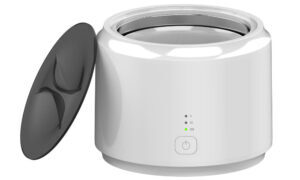
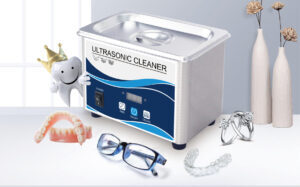
JL010 480ml 35W Denture Cleaner
Understanding How Dentures Become Dirty
Dentures spend long periods in a warm and moist oral environment, creating favorable conditions for microorganisms and organic deposits to accumulate. Similar to natural teeth, removable dentures can develop a layer of bacterial biofilm that adheres to their surfaces. This biofilm may contain bacteria, fungi, saliva proteins, food residues, and other organic materials, while mineral deposits can gradually develop when plaque remains undisturbed for extended periods.
Common contaminants found on dentures include:
Traditional brushing can remove much of this contamination, but mechanical brushes depend on direct physical contact. Small grooves, recessed areas, attachment points, and complicated denture geometries may therefore receive less cleaning action than easily accessible surfaces. Aggressive brushing can also create unnecessary abrasion, particularly when unsuitable abrasive products are used. This is one of the areas where ultrasonic cleaning can provide a useful complementary cleaning mechanism.
Do Ultrasonic Denture Cleaners Really Work?
The Short Answer
Yes. Ultrasonic denture cleaners can effectively remove many forms of contamination from denture surfaces through a process known as ultrasonic cavitation. The technology is particularly useful for disrupting biofilm and loosening food residues and other surface deposits from areas that may be difficult to reach with a toothbrush.
Numerous laboratory and clinical studies have investigated ultrasonic cleaning of removable dental appliances. Research generally shows that ultrasonic cleaning can reduce denture plaque and microbial contamination, particularly when ultrasonic treatment is combined with an appropriate denture-cleaning solution. However, results vary according to the equipment, operating parameters, cleaning solution, treatment duration, and condition of the denture, so the effectiveness of one ultrasonic cleaner should not automatically be assumed to apply to every machine.
Ultrasonic cleaning is therefore best understood as a mechanical cleaning technology rather than a sterilization process. Cavitation can physically disrupt and remove contamination and may reduce the microbial load on a denture, but a conventional ultrasonic cleaner does not automatically sterilize the appliance. Proper denture hygiene should continue to include appropriate brushing, rinsing, chemical cleaning when recommended, and professional dental care when necessary.
What Scientific Studies Show
Research published in dental and prosthodontic literature has demonstrated that ultrasonic cleaning can reduce contamination and biofilm on removable dental appliances. Clinical studies have compared ultrasonic cleaning with conventional brushing, chemical soaking, and combinations of these methods, with results indicating that ultrasonic treatment can be an effective component of a denture hygiene routine.
The technical advantage comes from the ability of cavitation to generate cleaning action throughout the liquid surrounding the appliance. Unlike a toothbrush, which can only clean surfaces directly contacted by its bristles, an ultrasonic cleaner can produce fluid movement around complex surfaces during operation. Denture geometries containing grooves, recesses, fitting surfaces, clasp assemblies, and other difficult-to-access areas can therefore benefit from liquid-based ultrasonic action.
The effectiveness of ultrasonic cleaning is also influenced by the cleaning solution. Water can transmit ultrasonic energy and support cavitation, but an appropriate denture-cleaning formulation can help weaken organic deposits and improve the overall removal process. For this reason, studies evaluating ultrasonic cleaning often consider the ultrasonic system and chemical cleaning agent together rather than treating ultrasonic energy as the only factor responsible for cleaning performance.
Dental laboratories and clinics may also use ultrasonic equipment to clean dental appliances and instruments because the process can remove contamination efficiently while reducing the need for aggressive manual scrubbing. The exact cleaning process, however, should always be selected according to the material and intended application of the appliance.
What Ultrasonic Cleaning Cannot Remove
Despite its effectiveness, ultrasonic cleaning is not a cure-all solution. Cavitation is most useful for loosening and removing contaminants that are physically or chemically attached to a surface, but heavily mineralized deposits can be much more difficult to remove.
Heavy calculus, hardened mineral deposits, and deeply established stains may not disappear completely after a standard ultrasonic cycle. Increasing the treatment time indefinitely is not necessarily an effective solution because once readily removable contamination has been displaced, additional ultrasonic exposure may provide diminishing returns.
When hardened deposits remain, professional dental cleaning or an appropriate chemical treatment may be necessary. Ultrasonic cleaning also cannot repair cracked acrylic, replace missing material, restore worn surfaces, or correct structural problems. A damaged denture should be inspected and repaired according to professional dental recommendations rather than relying on longer ultrasonic cycles.
How Ultrasonic Denture Cleaners Work
The Principle of Ultrasonic Cavitation
Ultrasonic cleaners generate high-frequency sound waves that travel through a liquid cleaning medium. Inside the equipment, ultrasonic transducers convert electrical energy into mechanical vibration, and the vibration is transferred to the liquid inside the tank. The resulting acoustic waves create alternating high-pressure and low-pressure cycles throughout the cleaning solution.
During low-pressure portions of the acoustic cycle, microscopic cavities or bubbles can form in the liquid. These bubbles expand and then collapse rapidly when the surrounding pressure changes. This phenomenon is known as ultrasonic cavitation.
The collapse of a cavitation bubble can generate localized fluid movement, pressure fluctuations, and shear forces. When these events occur close to a contaminated denture surface, the resulting mechanical action can disturb particles, biofilm, and other deposits. The cleaning effect therefore comes primarily from the physical effects produced by cavitation rather than from the sound waves simply “shaking” the denture.
Why Microscopic Bubbles Matter
The cleaning action comes from millions of cavitation events occurring throughout the cleaning solution. Each bubble is extremely small, but the combined effect of repeated bubble formation and collapse can generate significant localized mechanical action across an immersed surface.
Because the cleaning process occurs within the liquid, cavitation can reach areas that are difficult to contact directly with a toothbrush, including:
This does not mean that every recessed area receives identical ultrasonic energy. Cavitation distribution depends on tank geometry, liquid level, transducer position, frequency, acoustic coupling, and other equipment characteristics. Proper equipment design is therefore important for achieving consistent cleaning throughout the usable tank volume.
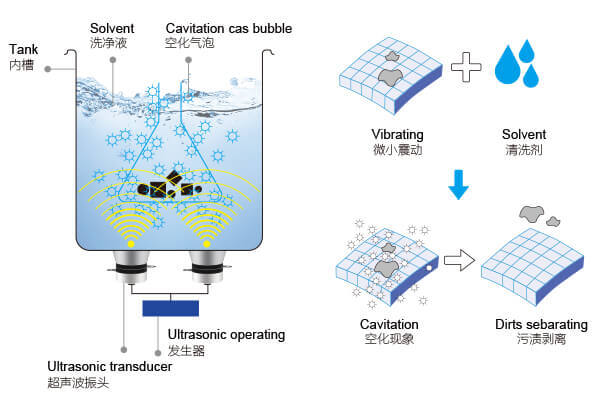
The Principle Behind Ultrasonic Cleaning
The Role of Frequency and Power
Frequency has a direct influence on the characteristics of ultrasonic cavitation. Lower frequencies generally tend to produce larger cavitation bubbles and stronger individual bubble collapses, while higher frequencies generally produce smaller bubbles and a different distribution of acoustic activity. The appropriate frequency depends on the material, contamination type, required cleaning intensity, and equipment design.
For denture cleaning, frequencies around 40 kHz are commonly used because they provide a practical balance between cleaning activity and compatibility with many removable dental appliances. Some specialized or consumer systems use frequencies outside this range, so frequency should not be treated as the only indicator of cleaning performance.
Ultrasonic power is equally important. Insufficient acoustic energy may produce weak cavitation and limited cleaning performance, while excessive or poorly distributed power can create unnecessary mechanical stress and may be unsuitable for sensitive materials. From an equipment-design perspective, the objective is not simply to maximize electrical wattage. A properly engineered system should provide stable ultrasonic output and sufficiently uniform cavitation throughout the intended cleaning zone.
The relationship between nominal power and actual cleaning performance is also not necessarily linear. Two machines with the same rated electrical power can produce different results because transducer efficiency, tank geometry, generator design, acoustic coupling, and power distribution all influence the amount and location of useful cavitation.
What Types of Dentures Can Be Cleaned Ultrasonically?
Ultrasonic cleaners can be suitable for many types of removable dental appliances, but compatibility should always be confirmed against the material and appliance manufacturer’s cleaning instructions. The same ultrasonic parameters should not automatically be applied to every dental appliance because acrylics, thermoplastics, metals, adhesives, and composite materials can respond differently to ultrasonic exposure and cleaning chemistry.
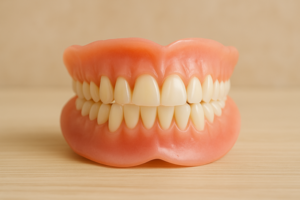
Denture
Acrylic and Partial Dentures
Full acrylic dentures and many partial dentures can be cleaned using ultrasonic equipment when the appliance manufacturer permits ultrasonic treatment. Partial dentures can particularly benefit from liquid-based cleaning because metal frameworks, clasps, and other components may create areas that are difficult to reach with conventional brushing.
However, an ultrasonic cleaner should not be considered automatically compatible with every denture simply because the appliance is removable. Existing cracks, loose components, damaged acrylic, previous repairs, or weakened attachments should be inspected before cleaning. When the condition of the appliance is uncertain, professional assessment is preferable to increasing ultrasonic exposure.
Retainers, Mouthguards, and Aligners
Ultrasonic cleaning may also be applicable to removable orthodontic retainers, mouthguards, night guards, and clear aligners, depending on the material and manufacturer’s instructions. These appliances can contain thermoplastic materials and other components with different resistance to heat, chemicals, and mechanical exposure.
For this reason, the appliance provider’s instructions should take priority over general ultrasonic cleaning recommendations. A cleaning method suitable for an acrylic denture may not necessarily be appropriate for every thermoplastic appliance.
Appliances Requiring Special Care
Special caution is appropriate for dental appliances containing delicate repairs, loose components, adhesives, coatings, decorative elements, or materials that have not been validated for ultrasonic exposure. The condition of the appliance can be just as important as its material composition.
If compatibility is uncertain, a low-intensity test under controlled conditions or professional guidance is preferable to assuming that all dental materials respond identically to ultrasonic cleaning.
Ultrasonic Denture Cleaner vs Traditional Cleaning Methods
Manual Brushing
Brushing remains one of the most familiar and important denture-cleaning methods. It provides direct mechanical action and can remove visible food residue and surface deposits effectively when performed correctly. However, brushing depends on the user’s technique, the shape and stiffness of the brush, and whether the bristles can reach the entire denture surface.
Common limitations include:
Repeated aggressive brushing can gradually alter the surface of some denture materials, particularly when combined with abrasive cleaning products. Ultrasonic cleaning provides a different mechanism by using liquid-mediated cavitation rather than direct bristle contact.
Chemical Soaking Tablets
Chemical denture-cleaning tablets are designed to help loosen organic deposits, reduce staining, and control microbial contamination. Depending on the formulation, these products may contain oxidizing agents, surfactants, enzymes, or other ingredients intended for denture cleaning.
Chemical soaking can be effective, but soaking alone does not necessarily provide the same physical disruption of deposits as ultrasonic cavitation. Contamination trapped in complex structures may remain attached if the chemical solution cannot adequately penetrate or mechanically disturb it.
Combined Cleaning Approaches
For many denture-care routines, combining different cleaning mechanisms provides a more comprehensive approach. A typical routine may include:
The purpose of combining these methods is not to make every cleaning cycle more aggressive. Instead, each method addresses a different type of contamination. Mechanical brushing removes accessible debris, chemical cleaning helps loosen or chemically modify deposits, and ultrasonic cavitation provides additional mechanical action in immersed areas.
Key Factors That Affect Cleaning Performance
Cleaning Frequency
Regular cleaning generally provides more consistent results than allowing contamination to accumulate for long periods. Fresh biofilm and loose food residues are usually easier to remove than deposits that have dried, mineralized, or become strongly attached to the denture surface.
For routine maintenance, ultrasonic cleaning can be incorporated into a regular denture-care schedule when the appliance manufacturer permits it. The exact frequency should depend on the appliance, cleaning solution, equipment, and recommendations provided by the dental professional or appliance manufacturer.
Cleaning Solution Selection
Water alone can support ultrasonic cavitation, but an appropriate cleaning solution may improve overall cleaning performance by helping loosen organic deposits. Chemical formulations designed specifically for dentures may contain ingredients intended to break down or detach proteins, biofilm components, and stains.
Many denture-cleaning formulations are designed to work through chemical action, while ultrasonic energy adds mechanical action. This combination can be more effective than relying on either mechanism alone.
Only cleaning solutions confirmed to be compatible with both the denture and the ultrasonic cleaner should be used. Harsh household chemicals, solvents, or inappropriate concentrations can damage certain polymers, metals, coatings, and adhesives.
Water Temperature
Temperature can influence cleaning performance because it affects liquid properties and the behavior of contaminants. Moderate temperatures may help loosen some deposits and improve the overall cleaning process, but higher temperature is not automatically better.
Excessively hot or boiling water should generally be avoided for dentures because some denture materials can deform when exposed to high temperatures. Temperature recommendations should therefore be based on the appliance material and manufacturer’s specifications rather than on the maximum temperature capability of the ultrasonic cleaner.
Cleaning Duration
Longer cleaning cycles do not necessarily produce proportionally better results. During the initial stage of ultrasonic treatment, readily removable contamination can be disrupted relatively quickly. As the surface becomes cleaner, additional ultrasonic exposure may produce progressively smaller improvements.
For this reason, the appropriate cycle should be determined according to the equipment specifications, contamination level, cleaning solution, and denture material. Many consumer ultrasonic cleaners use preset cycles to provide repeatable treatment, while professional equipment may allow greater adjustment for different applications.
Advantages of Ultrasonic Denture Cleaners
Several technical characteristics make ultrasonic cleaning useful for removable dental appliances. The most significant advantage is improved access to immersed surfaces without requiring direct mechanical contact with every contaminated area.
Improved Surface Access
Cavitation can generate cleaning action around complex surfaces, helping loosen contamination in grooves, contours, recessed areas, and other locations that may be difficult to clean manually. The effect is particularly useful when contamination is distributed across a complicated three-dimensional surface.
Reduced Physical Scrubbing
Because ultrasonic cleaning relies primarily on liquid-based mechanical action, it can reduce the need for aggressive physical scrubbing. This can be useful when the goal is to remove contamination while minimizing unnecessary direct abrasion of the denture surface.
Consistent Cleaning Results
Automated ultrasonic cycles can provide more repeatable treatment conditions than manual cleaning alone. A timer allows the same operating duration to be applied from one cycle to another, reducing variation caused by differences in brushing technique or cleaning time.
Non-Abrasive Cleaning Process
Ultrasonic cleaning does not depend on abrasive particles physically rubbing against the denture. The primary mechanical action comes from cavitation and fluid movement. This can provide a useful alternative when excessive mechanical scrubbing is undesirable.
However, “non-abrasive” does not mean that ultrasonic treatment is automatically harmless to every material under every condition. Cleaning chemistry, power density, exposure time, temperature, and the condition of the appliance must still be considered.
Broad Application Range
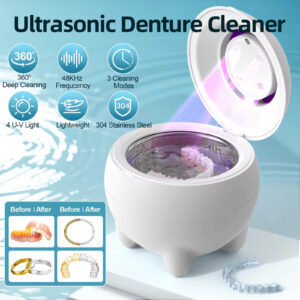
Depending on the equipment and material compatibility, the same ultrasonic cleaner can often be used for different removable dental appliances and other small items. This versatility is one reason ultrasonic technology is widely used in dental laboratories, medical facilities, jewelry cleaning, laboratory equipment cleaning, and other precision-cleaning applications.
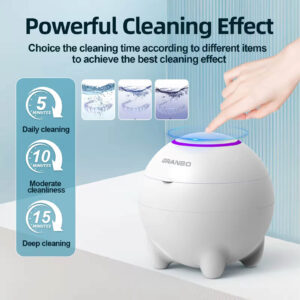
Powerful cleaning Effect
Choice the cleaning time according to different items
to achieve the best cleaning effect
Limitations and Common Misconceptions
Ultrasonic Cleaning Is Not Sterilization
One of the most common misconceptions is that ultrasonic cleaning automatically sterilizes dentures. This is not technically correct.
Ultrasonic cleaning can remove contaminants and may reduce microbial contamination, but a standard ultrasonic cleaner is not equivalent to a validated sterilization system. Sterilization requires a controlled and validated process capable of achieving the required level of microbial inactivation.
Ultrasonic cleaning should therefore be described primarily as a cleaning and decontamination technology unless a separate validated process establishes a specific sterilization claim.
Severe Calculus Deposits May Require Professional Treatment
Hardened tartar and mineralized deposits can become strongly bonded to denture surfaces. Once deposits reach this stage, ultrasonic cleaning alone may not provide sufficient mechanical or chemical action to remove them completely.
Repeatedly increasing the treatment time is not necessarily the best solution. Professional dental cleaning may be required when deposits remain firmly attached, particularly when removing them mechanically could damage the denture surface.
Device Quality Matters
Not all ultrasonic cleaners deliver the same cleaning performance. The effectiveness of an ultrasonic system depends on the interaction between the generator, transducers, tank, liquid, and operating parameters.
Important equipment factors include:
Poorly designed equipment may generate uneven cavitation, resulting in strong cleaning activity in some areas and weak activity in others. A higher nominal wattage does not automatically indicate better cleaning performance because acoustic efficiency and energy distribution are equally important.
Technical Features to Look for in an Ultrasonic Denture Cleaner
When evaluating an ultrasonic denture cleaner, the most useful specifications are those that describe how the equipment actually generates and controls ultrasonic energy. Frequency is important, but it should be considered together with generator stability, transducer configuration, tank design, power density, and operating controls.
Frequency Range
Approximately 40 kHz is one of the most common frequencies used for general ultrasonic cleaning and is suitable for many denture-cleaning applications when the appliance material is compatible. The ideal frequency is not determined by the number alone, however. The actual acoustic performance of the system depends on how efficiently the generator and transducers operate at the selected frequency.
Tank Material
Stainless steel tanks, particularly SUS304 stainless steel, are widely used because of their corrosion resistance, durability, and suitability for water-based cleaning applications. Tank construction also influences acoustic transmission and long-term equipment reliability.
Timer Functions
Programmable timers allow cleaning cycles to be repeated consistently and help prevent unnecessarily long operation. For household denture cleaning, preset cycle options can simplify operation, while adjustable timers may be useful when different appliances or contamination levels require different treatment durations.
Safety and Reliability Features
Useful design features may include:
These features do not directly determine cleaning efficiency, but they contribute to reliable and repeatable operation. From a manufacturing perspective, a practical ultrasonic cleaner should balance acoustic performance, electrical control, tank construction, user safety, and ease of maintenance rather than focusing on a single specification.
Proper Usage and Maintenance Guidelines
Recommended Cleaning Procedure
A typical ultrasonic denture cleaning process includes several straightforward steps. The denture should first be rinsed to remove loose food particles, after which the ultrasonic cleaner can be filled with clean water or an approved cleaning solution. The appliance should be positioned correctly in the tank or cleaning basket so that it is fully immersed and does not unnecessarily strike the tank during operation.
The recommended cycle should then be selected according to the appliance and equipment specifications. After the cycle is complete, the denture should be rinsed thoroughly, particularly when a chemical cleaning solution has been used. The appliance can then be stored according to the recommendations provided by the dental professional or appliance manufacturer.
The denture should not be dropped into the tank or handled roughly during loading and removal. If a basket is supplied, using it can help position the appliance consistently and reduce unnecessary contact between the denture and stainless steel tank.
Daily Maintenance
Regular maintenance of the ultrasonic cleaner helps preserve cleaning performance and equipment reliability. Used cleaning solution should be replaced when it becomes visibly contaminated or when the manufacturer’s instructions recommend replacement. Reusing heavily contaminated liquid can reduce cleaning consistency because removed particles and organic material remain suspended in the tank.
Important maintenance practices include:
Storage and Care
The ultrasonic cleaner should be stored in a dry environment and operated according to the manufacturer’s specifications. Water should not be left in the tank for extended periods unless the equipment is specifically designed for continuous liquid retention.
If cleaning performance changes noticeably, possible causes include contaminated solution, incorrect liquid level, unsuitable cleaning chemistry, transducer degradation, generator problems, or changes in acoustic coupling. Unusual operating noise or substantially weaker cavitation can also indicate that the equipment requires inspection or servicing.
Proper maintenance helps preserve consistent cavitation performance and extends the usable life of the ultrasonic cleaning system.
Are Ultrasonic Denture Cleaners Worth Using?
For many denture wearers, ultrasonic denture cleaners provide a practical additional method for improving denture hygiene. Their primary advantage is not that they replace brushing or chemical cleaning, but that they introduce a different cleaning mechanism capable of generating cavitation throughout the cleaning liquid. This allows mechanical cleaning forces to reach immersed surfaces that may be difficult to contact directly with a toothbrush.
The effectiveness of an ultrasonic denture cleaner depends on the complete system. Frequency, acoustic power, transducer efficiency, tank geometry, cavitation distribution, cleaning solution, temperature, treatment duration, and denture material all influence the final result. A well-designed system operated under appropriate conditions can provide consistent removal of biofilm, food residue, and other surface contamination, while heavily mineralized deposits may still require professional treatment.
The most practical approach is therefore to treat ultrasonic cleaning as one component of a broader denture-care routine. Regular rinsing, appropriate brushing, compatible chemical cleaning products, ultrasonic treatment when suitable, and professional dental maintenance each address different aspects of denture hygiene.
Ultrasonic technology cannot repair damaged dentures or guarantee sterilization, but its cavitation-based cleaning mechanism provides a technically established way to improve access to complex surfaces and reduce the amount of contamination retained on removable dental appliances. When the equipment parameters and cleaning process are properly matched to the appliance, ultrasonic denture cleaners can be an effective and repeatable cleaning solution for routine denture maintenance.